Orthos

Today: a quick offshoot of the boring church conversation we started last month. There are typically two paths offered by most churches to help people figure out if they are doing the spiritual life “right”.

———-

On the one hand you have: orthodoxy. This is a very good word that can also be quite loaded, depending on what circles you are circling in. Orthodoxy is a term that feels inviolable: if I’m not orthodox then I’m a heretic, right? And there’s truth there, historically, and in the literal definitions of the terms.

For our purposes today, let’s focus on the second part of the word, the doxy. Belief. There is a heavily western elevation of Orthodoxy as the way. Again, I am not referring to the traditions and doctrines of Christian orthodoxy, but more to the idea that what matters most is what we believe. 

To paraphrase Jesus, it’s the idea that, yeah, we love God with all our heart, soul, mind, and strength, but mostly just with our minds. The mind is the most important part. The heart is deceitful, the soul is hard to define, so let’s get our minds right. We think, therefore we are. 

As a result, terms and ideas get labeled as orthodox and then one gets punished for daring to question it. And this is how you end up with: Conformity.

(PS. This is where fundamentalism lands, along with a variety of other camps. To use our quadrant the bottom half tends to be all about Doxy/Belief).

———-

On the other hand, you have orthopraxy. Praxis=action, or practice. Beliefs are important, but what we actually do is what matters. Impact the world, do stuff, make things happen. Matthew 25 kind of stuff. 

Orthopraxy can become just as judgy and mean as Orthodoxy. It can become a soft form of cancel culture: “Oh, you don’t care about this issue, you didn’t go to the protest, you aren’t serving in this way, you don’t like this kind of worship? You are obviously a sellout/hypocrite/poser/etc.” 

It should be very clear, I hope, that I am not attempting to negate doxy or praxy…we need both! But, they have both contributed to the stifling conformity in the church. 

———- 

And so I would like to help introduce a larger audience to an idea that I came across in Kevin VanHoozer’s fantastic work: The Drama of Doctrine. He coined the term: Orthokrisis. Right judgment or discernment.

We need to be careful about our beliefs and grounded in our actions, but we also need to be willing to name our filters. Beliefs and Actions are not developed in a vacuum. A lot of what we consider to be orthodoxy or othopraxy can be deeply conditioned by our culture, our political climate, our news/social media feeds, etc. 

In a future post I will attempt to define a better filter for our cultural moment, but for now, I want to leave you with the challenge of thinking through your own filters given this introduction to Orthokrisis.

How do you apply your beliefs and actions to your moment, context, neighborhood, family, job, and places of play?

My hope and prayer is that Orthokrisis helps expand our imaginations for what Orthodoxy and Orthopraxy might look like in our local contexts.

An Excursus and Two Side Notes (a great title)

Does God move us or do we move God? I will come back to the issue of the boring conformity (see last 2 posts) that has settled on American church culture in some of the next posts. Today, though, I wanted to address an under-the-surface issue that is a subtle (but extremely influential) driver of conformity.

There is a theological undercurrent in many churches that originates from a similar root idea, even if those churches come from wildly different traditions.

The root idea is that God is essentially inaccessible (off somewhere else doing his thing), and so we need to do something to get God’s attention. To answer the opening question: we must move to get God to move.

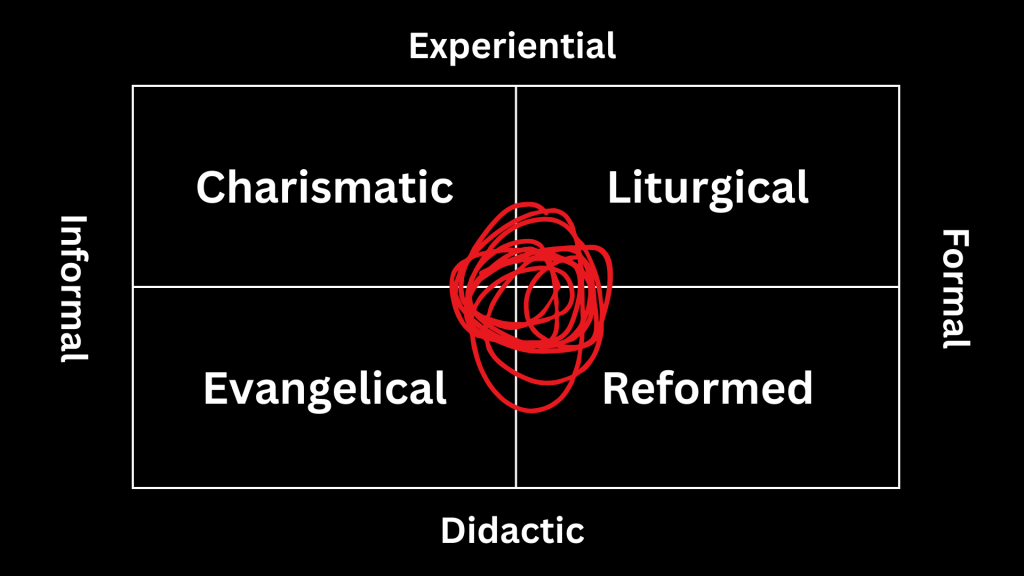
From my quadrant I want to pick on Charismatic (high experience/informal) and Reformed (high didactic/formal) churches for a moment (in no small part because they are opposites, at least according to my diagram, but also because true practitioners of each would be scandalized at being lumped together 😀…so this will be fun).

For Charismatics, there is a strong emphasis placed on worship and prayer (this is good!). But, the subtle (or not so subtle) teaching here is that YOU (me/we/people/etc) need to worship and pray really hard to get this inaccessible god to show up and do something cool. 

[[Side Note: much has been written about the charismatic take over of worship songs. This article and this book and this book are great examples. One quote from the article: “Adam Perez said the four most influential megachurches come from the charismatic tradition of Protestant churches. All of them, he said, have a spirituality that believes God becomes present in a ‘meaningful and powerful way’ when the congregation sings a particular style of worship song.”

He goes on to say (and this is sobering): “The industry itself becomes this invisible hand,” he said. “We don’t name the theology of praise and worship — we just assume it. And we use this kind of song repertoire to reinforce it.”

That little phrase “we just assume it” contains multitudes. Conformity flourishes in the soil of unexamined reality.]]

While there is a lot to be said about all of that, take note of this statement again: God becomes present in a meaningful and powerful way when the congregation sings. We have to move to get God to move.

For Reformed folks (who are snorting their coffee right now in outrage over this comparison): we have a very different presentation, but a very similar process.

In Reformed circles one must doctrine correctly, think correctly, study and teach the Bible correctly, obey correctly, submit correctly (you get the idea) and then God will be pleased with us and move (see: “right doctrine leads to right living”, the title of any number of sermons from Titus).

We’re still stuck with “we move to get God to move.”

To cut to the chase, this is formulaic spirituality and the only way out is relational spirituality. (PS. formulaic thinking ultimately leads to conformity).

[[Second side note: This is one of the best, and most important, books I have read in the last five years and it walks a beautiful line of being technical and accessible while making a clear case: we are wired for relationships. Another excellent resource would be the collected works of Eugene Peterson. Start here.]]

In a relational theological paradigm (based on the doctrine of the trinity), we are invited into the community of God by God through God. God is the prime mover and initiator. 

But (and this is important), the initiated movement is towards relationship. Relationships have give and take. God is already here and moving and he wants us to join in! To participate.

There are a lot of people who are genuinely and earnestly worshiping and learning doctrine (good things) hoping God will show up, meanwhile God is already there doing stuff wondering if any of these worshipping/doctriners will join the party!

Sort of like this

Part of my thesis in these posts is that we have a deeper problem than “youtube and instagram are ruining the church.” The problem is both theological and practical, and we’ll get into that more next time… 

The Conformity Quadrant

Last week I wrote about how cultural pressure has led to a protectionist mindset in churches, leading to a boring conformity.

Let’s explore this a bit more. First, a disclaimer: I am a pastor, not a researcher. Most of what I share here is from experience. Other sites can give you the data and statistical analysis. But, I have been doing this for about 20 years, which simply means: I’ve seen some things. And so these are my observations.

In this moment of conformity, we have settled into four camps. (By we: I mean evangelicals, and I use this word here in the broadest possible sense. I will use it again in a moment in a slightly different fashion, to describe a sub-category, I apologize for the confusion that will ensue!)

Here’s a handy chart!

And here’s a quick breakdown**: 

  • Liturgical churches
    • High structure (all churches have structure, but the high structure expression on this chart use structure as a feature: it’s part of their “thing”)
    • Strong experience (the liturgy is the driver for formation, not preaching)
    • Examples: some Presbyterian expressions, neo-Anglican, CRC, etc
  • Reformed churches
    • High structure (their structure is based on hierarchy rather than liturgy: in fact hierarchy is the organizing principle of life, from family and home, to church, to doctrine, etc)
    • Strong didactic (someone higher up in the hierarchy will tell you what to do)
    • Ex: Bethlehem Baptist (Piper), Grace Community (MacArthur)
  • evangelical churches
    • Low structure (structure is there, but it is for organizing ministry programs and building the organization, not a main feature. In fact, most non-denominational churches will downplay their structure, even though they might be HIGHLY organized)
    • Strong didactic (preaching is a primary feature, often the main vehicle for formation)
    • Ex: Saddleback, Willow Creek, etc
  • Charismatic churches
    • Low structure (similar ethos here to the evangelical churches)
    • Strong experience (here the experience is focused on worship, the Spirit, and prayer, rather than liturgy)
    • Ex: Hillsong, Elevation, etc

**Notes: this breakdown is pretty similar to John Mark Comer’s 4 gospels

This is a simplistic summary and I know practitioners of each would be pretty frustrated by my reductions. In real life, it’s more complicated and nuanced than this, we all get that (right?!).

Over my lifetime, there have been shifts of energy (and power) amongst these quadrants. In the 90’s the “evangelicals” were winning, in the late aughts and early 2010’s the neo-Reformed took over the discourse, and this decade the Charismatics are dominating. (More to say about all of this as we move forward.)

For now, the movement through the grid leads to a boring conformity and a lack of imagination. What I hope to point to, ultimately, is something like this…

…because what is going on in each quadrant is not “bad” per se, but the copy and paste mentality needs to go and be replaced by an integrative approach that recognizes the good gifts of different traditions, but reimagines them for specific contexts.

In my community (small college down in the middle of California), we have a LOT of coffee shops. We have a handful of Starbucks, a Peets, a popular Bay Area mini-chain, and a popular Sacramento shop that opened a store here (this is a common issue in Davis, we repeat cool Bay Area and Sacramento things rather than create our own).

I go to Pachamama. It’s one of the few truly local options (plus its model is really cool). My contention is that the church should be more like Pachamama than Starbucks, a local expression of Good News rather than a cut-and-paste copy.

Boring Church

One of the griefs of middle age is the sober realization that your youthful dreams of changing the world are probably not coming to fruition.

I know, I know: what a cynical and sad way to start! I used to roll my eyes at older leaders who said similar things to me when I was in my twenties and starting out on this leadership journey.

A couple decades ago I was certain my generation would figure it out. There was no way we would repeat the mistakes of our parents and grandparents and the future of the church would be glorious and awesome.

Nope, we are repeating the same mistakes over and over again.

—–

Ok, that was the dark opening to my relaunching of this blog: nothing has changed, nothing has gotten better. Woohoo!

On the lighter side of things: I am still full of hope. The church is still a beautiful force for good, and (for better or for worse) the central player in God’s mission to restore shalom. I love this work and our little kingdom outpost here in Davis, CA. 

But, we are not the generation to “figure it all out” and the next one after us will probably repeat a lot of our mistakes. I rage against the fact that there is nothing new under the sun, but find this truth liberating at the same time. It right-sizes my grandiosity.

And so, from that place (cynically hopeful??) I want to process some of the things I’ve learned, some of the things I see, and where I am finding hope these days. Thanks for reading!

——

Observation 1: The Church in 2024 is extremely boring.

Let’s define boring! According to the dictionary boring means: not interesting, tedious. Some synonyms include: repetitive and unimaginative. That last word is key because, and I want to be clear here, the opposite of boring is NOT entertainment. 

The answer is not a good show, but a holy imagination. Twenty years ago Alan Hirsh and Michael Frost wrote: “It is not too harsh a judgment to say that most people in the Western church simply cannot see beyond the Christendom mode they know so well.”

And, oooof, that is still true, even more so today than twenty years ago (imho)!

At the risk of being overly simplistic, here are two reasons why we’ve lost our imagination and settled for boring church.

First, outside the church, the church lost the culture wars. I know some people are still fighting, but these are the little battles that linger after the main war has ended. We are in a post-Christian world now and the church has been moved to the fringe. 

This is scary, and it breeds a circle-the-wagons/stop-taking-risks/keep-the-customers-happy mentality. I get it. There is a lot of pressure to maintain and a lot of fear of losing (people). But that fear is crippling and stifling. Nothing new happens because new might be too disruptive. 

Why disrupt when everything else feels in flux?!

Second, inside the church, churches have chosen pragmatism over imagination. There is a desperate searching for things that “work.” If church A is doing something that appears successful, let’s copy it, so that it works for us. Next thing you know, every church looks the same.

This is a failure of nerve and an abdication of responsibility

We are not robots, we are co-creators, shaping the future with God. We must reclaim imagination!

I will say, as a word of caution, daring to imagine a different future, and forging ahead into new territory is costly. I’ve been called some names, friends! But, God has not given us a spirit of fear, but one of power, love, and sound judgment. 

This is just beginning…more to come next week. For now, let’s stoke that holy imagination and start dreaming again about a different future. 

Email 1 (3/23/2020)

So, I’m turning 40 this year. One of my goals for the year is to read back through my 40 favorite books. I broke that down into two categories. 20 favorite novels or “fun” books, and then 20 formational books, books that have shaped me, my ministry and theology.

As I’ve been reading back through the formational books, a common theme that has stood out is the incarnation: the “in the flesh” reality of the God we meet in Jesus.

My theology, my philosophy of ministry, is so tied to this idea: (a) that God came toward us, became a human being to with us, and (b) that our call then is to “incarnate” that good news for other people, to be a flesh and blood presence with other people.

Quick side step: all throughout human history (and the story of Scripture) we see people trying to de-incarnate God, depersonalize God. This is what the writers of Scripture call idols. 

God is not anti-idol because he hates statues or because he thinks art is dumb. He is anti-idol because idols are relationship killers, they keep God at a distance, they fundamentally work against incarnation.

“Those who cling to worthless idols turn away from God’s love for them.” Jonah 2:8

The coronavirus crisis creates a conundrum for incarnationalsists (a made up word). In a world where we socially distance ourselves from flesh and blood out of love, in a world where we can only be with each other digitally, what does that mean for presence, relationship, and withness?

Personally, this really messes with me. And not just theologically. I am not a big showy person. 

I don’t like the cameras 

and the flash 

and the “look-at-me” tendencies of online church.  

When your world turns around, 

when up becomes down, 

when the old patterns don’t fit the new paradigm, 

what do you do

Paul, the guy who wrote most of the New Testament, wrote all that stuff because he couldn’t be with people

So, he wrote a bunch of letters. And in many of his letters he expressed his grief at not being able to be with the people he was writing to.

Romans 1:11, II Timothy 1:4, Phillipians 1:8, I Thessalonians 2:17

“I long, I long, I long to see you, to be with you.”

And so that’s where we start:

With the grieving of distance.

The longing to be together.

And the writing of letters.

More to come on Wednesday.

Grace and Peace,

Steve

40 for 40 (January 2020)

The goal of 40 for 40 is two fold: (1) I want to take some time (a year) to slow down, stop reading so much new stuff, and (2) create space to revisit books that I have loved or considered formative to this point in my life. 

Part of the quest is to fight my propensity to consume. I love reading new things and that’s not bad, but it does make it hard to deeply digest, or to go back and revisit. New is always better, right?

So, my hope this year is that I’d spend some time reflecting on the journey to 40, sit with some past favorites, get to know the “old Steve” a little better, and see if these books I’ve loved have aged with me, or if they are simply relics (ebenezers) from the past.

I began with Everything Is Illuminated by Jonathan Safran Foer. For the past 15 years, if you had asked me: “Steve, what is your favorite book,” there’s been a 90% chance (or better) that this would be my answer.

I first read this book in the fall of 2003 on the advice of one David Crowder. I met him at a concert that my friend was running lights at, and I asked him what I always ask people: what is the best book you’ve read this year? He said, “Everything Is Illuminated.” He had just released Illuminate (coincidence?).

I re-read the book two more times: once on a trip to India in the fall of 2004, and again (in hardback for the first time) in 2007. 

All three previous readings were in my 20s, pre-marriage, and well over 10 years ago!

My takeaway re-reading it now: it is a young man’s book.

It’s still amazing in many ways. Hard to believe the author was in his 20’s when he wrote it. The scene where he describes the Nazi’s coming to take over his grandparents village is still one of the most harrowing passages in any book I’ve read.

It’s a book about memory and making sense of the stories that have produced us.

And it’s great. But as I said before, it is a young man’s book.
Full of fury and urgency and sexual tension. 
Full of longing and a desire for everything to mean something.
But not as weighty as I remember it feeling 15 years ago.

Young people have, and can express deep wisdom. 
And getting older is no guarantee that we will grow in wisdom.
And yet…weight. Everything Is Illuminated just feels lighter now than it did then.

Which, interestingly, is sort of what the book is all about: memory, how we change and grow and evolve as people, how the perception of an event changes depending on our moment in time and our proximity to that event.

It’s a brilliant book, written by a brilliant young man, and I mean that in the best sense possible.

—————

Next up is The Book of Lost Things. There was no method to choosing this book next, but it makes for a fascinating contrast. 

The Book of Lost Things is also a clever and a wonderful bit of writing about memory and tragedy and processing the traumatic events we experience in life. (First read in the fall of 2007.)

John Connolly reimagines classic fairy tales as the main vehicle for his narrative. I remember this technique being more shocking the first time around. I don’t know if I’ve just read more gnarly things, or watched too many movies, but there was very little shock value during this reading.

The particular copy I have has a big section at the end that gives the reader the background on each fairy tale and I had never read that before, so this experience was much different simply by taking the time to read through all that information. 

I found the experience of reading this book much easier than I remembered it, but the ending was no less meaningful (and it is one of the best endings to any novel I’ve ever read). 

And it’s the ending that gives the book weight and that provides a sharp contrast to Everything Is Illuminated. This is an old man’s book. It has less urgency, but more weight to it.

And so, my initial response, two books in to this adventure, is a sense of (a) relief. I confess to being mildly concerned that I would be devastated by “old Steve’s” taste. But, (b) also a sense that it is good to be in a different place than I was back then. 

Can’t wait to share more next month…  

40 for 40 (2020 Books)

Yesterday I published my 2019 book list. Check it out.

Today, let’s talk about 2020. Happy New Year!

I turn 40 this year. This milestone is obviously a time to pause and reflect, and one thing I’ve decided to do is to set a very different reading goal for the coming year. (My other big goal is to try to run a marathon).

This goal comes from two places. First, our church community is thinking a lot about spiritual formation and disciplines this year. One of my personality traits is to constantly seek and acquire new information. This is not a bad thing. But sometimes I can get caught up in needing to always be reading the “new” thing.

So part of my goal this year is to cut down the flow of new information, go a bit slower, and revisit some of the things that have formed me over the years.

Which leads to part 2: I’ve read a lot of things and been deeply formed by a lot of what I have read. There are a number of books that have been extremely important at different moments, but many of them I haven’t revisited. Some of those moments are now many years old. I’m interested to see: were these books I loved about that moment in time, or was there something timeless about what I was encountering?

Either way, it will be an interesting means through which to reflect on my 40 years. My hope is to then post something here about each book, what the original moment was like, and what it was like to read that book again at this stage of life.

A few ground rules: I could only pick one book from an author, even if I REALLY like that author (I did make one exception to this rule, but rules are made to be broken). I also sometimes picked a book that was more representative of the author, and not actually the book I enjoyed the most (this will make sense later on when I do the reviews). I also picked 39 because I want to leave room to remember something or change the list if needed. Finally, I tried to pick books from many different eras of my life.

Here’s the list:

  1. The Holy Longing
  2. A Community Called Atonement
  3. Surprised By Hope
  4. An Unstoppable Force
  5. Reaching Out
  6. The Divine Conspiracy
  7. Jesus Wants to Save Christians
  8. With Justice For All
  9. The Gift of the Jews
  10. Persons in Relation
  11. The Drama of Doctrine
  12. Tattoos on the Heart
  13. Blue Like Jazz
  14. Christ Plays In Ten Thousand Places
  15. Five Smooth Stones For Pastoral Work
  16. The Shaping of Things To Come
  17. Searching For Home
  18. To Change the World
  19. Church Next
  20. You Are What You Love
  21. Between Two Worlds
  22. A Band of Misfits
  23. What the Dog Saw
  24. Traveling Mercies
  25. For The Time Being
  26. Everything is Illuminated
  27. A Heartbreaking Work Of Staggering Genius
  28. And The Mountains Echoed
  29. Book of Lost Things
  30. High Fidelity
  31. The Fortress of Solitude
  32. My Name Is Asher Lev
  33. Franny and Zooey
  34. The Fault in our Stars
  35. Plainsong
  36. The Kid From Tomkinsville
  37. Angela’s Ashes
  38. The Absolutely True Diary of a Part-Time Indian
  39. The Tender Bar
  40. The Hate U Give


Books of the Year

This year I got back on track and achieved my reading goal: 75 books! Here are a few that stood out to me (in no particular order):

Category 1 (Spirituality/Theology):

  • The Year of Small Things: Life in Davis has created a sort of reverse culture shock for our family after years of living in the “hood.” There was a moment on the soccer field this fall where we discovered that a family on our team was looking at the two houses for sale in our little development. The dad made it very clear they were really only looking at the more expensive of the two. That type of thinking is extremely prevalent here, and so figuring out how to do justice, love mercy, and walk humbly is actually more complicated than we expected. This book has been a good gift to us, creating a lot of great conversations about how to live counter-culturally in this place we find ourselves in.
  • The Kingdom Life: Our church community is going to be experimenting with a year long journey through various spiritual disciplines, so I read a ton of spiritual formation books this year. This was the best book on formation I read. It is a great blend of theological reflection and practical ideas. Plenty of content to generate conversation as well.
  • Strengthening the Soul of Your Leadership: In all of that formation reading, this book stood out, partly because Ruth is the best, and partly because this was the one formational book that focused on the life of the leader.
  • ReUnion: Every year there’s a book that ends up on my list, and in retrospect I have no idea how or why it did but I am sure glad that it did. Here’s 2019’s version. Bruxy is character, but his writing and thinking is extremely refreshing. This will be one I go back to often in the coming year(s).
  • Faith Formation in a Secular Age: Hands down this was the most consequential book I read this year. Fair warning: it is not easy to read. He repeats himself a lot, he quotes many, many people, there are a billion footnotes, and a lot of terms that are not familiar to most outside of academic circles. But it is so good and so important for any church that is serious about mission in the 21st century.
  • Honorable Mentions: Formational Children’s Ministry, Good News For A Change, The Color of Compromise, Desire of the Everlasting Hills, Raising Disciples, The Strangest Way, Faith For Exiles, The Making of An Ordinary Saint

Category 2 (Non-Fiction)

  • The Away Game: There are a million, billion, fascinating stories happening all the time, and one of the gifts of books is discovering what a few of those stories are. Here’s a great example: the story of the Football Dreams academy and the search for the “Next Messi” among African teenagers. Fascinating!
  • The Good Neighbor: Mister Rogers has experiences an incredible resurgence in this cultural moment. The book is excellently put together and does a great job exploring Rogers’ faith background as the foundation for his TV philosophy.
  • Improv Nation: If I had to pick one book for book of the year, this is it. Some books tell great stories, some books are full of incredible ideas and information, and some books are just brilliant writing. And then there are books where the author pulls of all three. And this is what we have with Improv Nation. A wonder to read, while at the same being informative and full of unreal stories.
  • The World As It Is: Some will write this book off as Obama propaganda, or an attempt to justify a particular career era (by the author), and it may very well be both of those things. That said, what this book really is is a reflection of the toll positions of power take on people. Spoiler Alert: the toll is significant.
  • She Said: This book is being heralded as an inside look at the story that launched the #metoo movement, and it is that. But once again, so much more is going on here. In our era of deep distrust of the media, this book is a case study in just how deeply researched news stories that comes from major publications are (and have to be). Sure, some stories get published too soon or without enough corroboration, but if you want to know what really goes into reporting big, breaking, stories check this out.
  • Honorable Mentions: The Job, The Power of Habit, Atomic Habits, I’ll Be There For You, Talking To Strangers

Category 3 (Fiction)

  • Simon Serrailler Series: I’ve spent the last two years reading various mystery series, and this one is great. It’s very character driven, very British, and can be a bit slow (in comparison to a typical American detective novel), but it is so, so good. These are great novels that happen to be about a detective, rather than detective novels.
  • There There: Some debut novels make you wonder how did this happen? How did this thing come out of someone who had never done this before? This is one of those books, plus it’s a fascinating look at the city of Oakland.
  • Honorable Mentions: On the Come Up, Witch Elm


Books of the Year

Amy and I sat down the other day to review our goals from 2018 and set some new ones for 2019. One of my goals for 2018 was to read 75 books (oops), and blog more (haha)! (I also had a goal to look into a lead pastor position if the opportunity presented itself, so check).

Consequently, 2018 was a big year of transition for our family and so many of our goals had to be massively readjusted. For 2019 I am not making any big promises: I’d like to write more, I’d like to read more, but this new job is a beast and so who knows (smiley face emoji). Nonetheless, I humbly submit my books of the year…

Top 5 Books of 2018:

Hero Maker//Gaining By Losing: These two books are foundational for understanding where things are headed at our little church in Davis. Both are focused on the essential discipleship tasks of equipping and sending. They challenge us to change the scorecard from building our kingdoms to building THE Kingdom.

God Is Stranger: Krish Kandiah is (probably) my favorite. One of my first series at Discovery was based loosely on his excellent book Paradoxology. This book picks up in a similar place challenging us to examine the weirder (and stranger) stories and characters in Scripture, because those are often the best places to meet our God. Krish smartly, but accessibly, helps us navigate the complexities of Scripture and our faith.

Reading the Bible For the Love of God: There are a lot of books out in the world on how to read the Bible. Most of them, in my humble opinion, get bits right here and there but then you have 150 pages of stuff that isn’t all that helpful. This is an “older” book that I finally read this year and as I read it I had the experience of realizing this was the book I had always been looking for. Now, when people ask me about a resource to help them understand and read the Bible this is the go-to.

Little Fires Everywhere: I did not read much outside of theology/church and crime mysteries (more on this in a moment). But I did dip outside of those boundaries a few times and in this case it was well worth it. Celeste Ng is a fantastic writer and this book will thrill you with her skills, keep you guessing until the end, and make you think about many of the layered issues in our world around race, culture, class, immigration, and raising kids.

The Fifth Risk: Michael Lewis can make anything interesting. I am convinced of this now more than ever. In this book, which I believe started as a long-form article and ended up a short book, he takes the riveting topic of government bureaucracy (I know, right), and makes it fascinating and vital.

Addendum to the Top 5:

Eldership and the Mission of God//The Board and the CEO: I have spent the last few years thinking, praying, and pondering deeply over the question of church/ministry boards and leadership (and the interaction between boards and senior leaders). These relationships are tricky and I’ve seen the dark side of this part of church life more than enough times. As with the “how-to-read-the-Bible” genre, there is a great lack of helpful resources in the “elder” genre. These two books were good gifts this year. Both do an excellent job walking through perils and pitfalls, but also painting a picture of what a life-giving, healthy board/leader relationship should look like. Pastor/elder friends, don’t read another book until you’ve worked through at least one of these!

Finally:

My sub-challenge in the reading category was to start working through a genre that I normally don’t read. A friend gave me a list of mystery novels to tackle, and so that became the theme of 2018. I read 20 mysteries this year, and it was so much fun I will continue on into the new year. I would highly, highly recommend Tana French’s Dublin Squad mysteries. They are easily the best writing of the 4 series I’ve read so far. You will feel like you know Dublin after you’ve read them. They are also a little weird (in a wonderful way) and walk the line between realism and the fantastical. If this doesn’t make any sense, just read a few of them and you’ll see what I mean. I strongly suggest reading them in order. If you don’t like it I’ll buy your copy off you for my own self.

Happy reading in 2019!

Books of the Year

2017 was a pretty good reading year, 60 books completed plus a variety of resource books/reading (which I don’t count). Not bad for this stage of life. So, in no particular order:

  • The Imperfect Pastor
    • This was the book of the year for me. Timely, humble, earnest and just the words I needed to keep going at this crazy calling. I had never heard of Zach Eswine before this book, but I am now a huge, and grateful, fan.
  • Barbarian Days
    • If I were to write this book it would be a “San Francisco Giants Fan Days” or something like that. This is a long meditation on our passions and hobbies and how those shape and organize our lives, which I totally get and very much appreciate.
  • Just Mercy
    • If there is an energy that drives a lot of social justice work it is anger. Which makes sense: injustice should make us angry. The problem is that when it comes to communicating about issues and causes anger only gets you so far. And then a bunch of angry people yelling about their cause gets loud (and a little obnoxious). Bryan Stevenson is one of the most humble, quiet, and yet deeply passionate people working for justice and shalom in our world. His voice is so fresh and so inspiring and there are some INCREDIBLE stories in this book. Please read it.
  • The Tech-Wise Family
    • I deeply appreciate Andy Crouch’s approach here, because he moves us beyond the issue (technology and parenting) to what is really true and important: raising wise children (and becoming a wise person in general). More than thinking about smart phones and lap tops, this book challenged me to think about modeling wisdom and how I am leading our kids to a life of pursing wisdom.
  • Ready Player One
    • I met with a group of guys fall of 2016 into the new year for discipleship, and we often met in a sports bar in Rockridge. This bar was close to where one of the men was living at the time so his wife would come down and wait for us to wrap up so the two of them could hang out. While we talked, she read. I’d always end up talking to her about what she was reading and one time she very sheepishly told me about this book (virtual reality, mystery, sci-fi, etc), and I said “I’m in!” I completely enjoyed every page of this book. It’s got 80’s references, music/movie/book references, a total nerd fest. It would have been the novel of the year (but it got beat out in the end by a truly remarkable work of fiction). Still, this was an amazing, satisfying read that I will likely pick up again. It is also being made into a movie, a feat that seems impossible (but I guess Spielberg is on it, so we are probably in good hands).
  • Kill ‘Em And Leave
    • I love musician biographies. I try to read a few each year, but this was the only one I got to in 2017. However, it was a doozy! I know very little about James Brown outside of “I Feel Good” (which used to be the intro song for Giants broadcasts back in the day, which sort of proves my earlier point). This was a very educational read, one that had me running to Spotify or Wikipedia to hear more or learn more. James McBride is also an incredible writer, which makes the whole thing worth your time whether you are interested in the subject matter or not.
  • Paradoxology
    • The other new voice that I am now a huge fan of now is Krish Kandiah. This book, along with God is Stranger, are great introductions to his work and thinking. Kandiah invites us into the weirdness and strangeness of Scripture and then pulls us through to the other side where we can exercise a stronger faith for having taken the journey. His writing is very accessible, even though he delves into some deep waters. My Writer of 2017.
  • As Kingfisher’s Catch Fire
    • I have a friend who, if he knows an author has X amount of books, will purposely save one of their books so that they never get to the end. In his words: he would rather live in a world knowing there’s at least one more book to be read (by__________) than not. I sort of get it because when Eugene Peterson decided to stop writing I kind of freaked out. I haven’t read all of his books, yet, but there will come a day when there is only one more. In the meantime, though, Peterson did publish this new work, a collection of sermons from his preaching ministry. You can see all the roots of his writing ministry in the these sermons. They are beautiful, and served as my devotional reading for about three months. I’m not sure what I will do when I come to that last book, but for now I continue to treasure Peterson’s words, he is a giant.
  • The Hate U Give
    • The novel of the year. I read this on Amy’s recommendation. Wow. There’s a lot one could read regarding police brutality these days, but this book humanizes the issue (both sides) in a way nothing else has (to my knowledge), it doesn’t provide any easy answers, and it will stick with you for some time.
  • Telling the Truth
    • I’m embarrassed to confess that I know Frederick Buechner far more from quotes than from original sources. This book came recommended by Dad, and it was, in many ways, a fitting sequel to The Imperfect Pastor. These two works, together, were fuel for the craft this year, and will be returned to again and again.
  • The Beginning and The End
    • Here is a short, but extremely profound, book that picks up where Dallas Willard leaves off. I have now made it a required intern reading text, and it is an excellent summary of the larger narrative arc of Scripture and how that arc informs our hermeneutics. Narrative theologians add this one to your tool bag.
  • Barking to the Choir
    • One of the gifts of books is they introduce you to people who remind you of certain truths: that we live in a beautiful, God-bathed world, and that there is hope and a better story to be lived and told. Greg Boyle is one of those people for me. Barking to the Choir is a bit more somber than Tattoos on the Heart, but still full of joy, humor, and deep insight into the power of compassion to change hearts.

Happy Reading in 2018!