Review: Why Holiness Matters

This month I will highlight a couple of books by friends and acquaintances. Up first is Tyler Braun‘s Why Holiness Matters. I first came across Tyler when I read this post and discovered we have some overlap in our stories. Here’s my review of his first book.

—–

Peel back the layers and you will find that one of he greatest fissures in modern Christian thinking lies between authenticity and rule keeping. Most people won’t lead with either of these labels, but they are there.

I work with college students and we have both types of students: those who just want the rules, just want a checklist, and those who use the quest for authenticity as a trump card, justification for poor decisions.

There is a third way, though, and this way is the subject of Tyler Braun’s strong effort: “Why Holiness Matters.” Braun argues that while most in the millennial generation will resonate with authenticity thinking, there is something better that Jesus offers: holiness.

Braun does his best work by taking this old idea and making it new and fresh for his contemporaries (although there’s plenty here for non-millennials as well).

I appreciated Braun’s relational approach to the conversation: holiness is not new (or better) behaviors, nor is it something we simply feel (or drift) our way into. Rather holiness begins with new affections. Our relationship, love of, and connection to a holy God leads to holiness.

I especially enjoyed the chapters on community and mission. Braun does well to emphasize that holiness is a communal process and draws us into community, it’s not a solo pursuit. But, holiness doesn’t lead us to lock the doors and keep the bad people out. We are compelled back into the world to love and serve our neighbors.

A solid effort, and a book I will likely use with students this year.

Sometimes we don’t need new words, we just need new definitions and conversations about good, old words.

Game Change

I wrote yesterday that Game Change is possibly my favorite read of the summer. Whatever your political views, the 2008 presidential election cycle was high drama and full of compelling stories. The authors focus on four campaigns (Obama, Clinton, Edwards, McCain), providing all kinds of interesting background.

There are, undoubtedly, numerous reasons why Obama won. But as I was reading two aspects of Obama’s campaign stood out to me again and again:

  1. The Obamans (as the authors refer to the campaign) had a motto: no-drama-obama. They knew stuff would come up, they new their opponents would hit them hard, but throughout the whole thing Obama was about at straight-line as you can be. Very few ups and downs, very few emotional outbursts, and a lot of methodical, rational decision-making. Clinton on the other hand: wildly emotional, a roller coaster of highs and lows. McCain: wanted as little information provided to him as possible (Obama on the other hand puts baseball nerds to shame with the amount of information he processes)…as a result McCain was all over the place, following his gut instincts to the bitter end. Edwards, well, you can only imagine the drama there.
  2. The other fascinating thing to me was this: Clinton, Edwards, and McCain all had one person on their team who was highly competent and extremely dysfunctional. Extremely. (You could argue that Hillary had two of these people in her camp if you include her husband). Each of these people caused fissures on their team that proved, in the end, to be fatal. Obama had some personalities on his team too. But, the Obamans got caught up in the historical nature of the campaign (you might say they remained focused on the mission) and that kept some of the personality and ego issues to a minimum.

Fascinating stuff and a lot of implications for leaders: keep things steady and focused and choose your team well!

Wholehearted (A Final Rolling Stones Post)

The third and final installment of a three part series (“Honing Our Chops”) that first appeared at Faith ON Campus:

[I recently finished Life by Keith Richards, lead guitarist for the Rolling Stones. When most people think of the Stones they probably think of Mick Jagger first (no thanks to Keisha and Maroon 5). But Keith has really been the leader, glue, and engine for the band that turns 50 this year. I found a lot of what Keith writes about in Life to speak into my vocation as a Campus Minister. These are my reflections on Keith’s insights.]

“We just wanted to be a great blues band. That’s all we played [the blues], until we actually became it.” from Life, p. 158.

One of the themes that becomes very clear, very quickly, when reading Life by Keith Richards is that the Rolling Stones never set out to be an epic, culture changing rock n’ roll band. They were deeply influenced by the Chicago blues (Muddy Waters, etc), and that is, in many ways, how they still view themselves to this day: a Chicago blues band from London.

Not that they didn’t have ambition. They wanted to be a great band. But they had no idea what they were getting themselves into.

When students show up on campus as freshmen there are some who just want to party, and a few others who are there to get a degree and get on with it, but the majority of students come with significant dreams and aspirations.

They may not say this to the first people they meet at school, but they come wanting, believing, even knowing, that they can, and will, change the world.

But then life happens, disappointments accumulate, frustrations with classes and professors set in, and some of the gleam and shine of college begins to fade.

There is a kind of lostness that many students wander through around the mid-way point of their college experience. Should I stay in this major? Should I transfer schools? Is this really worth all the money and debt?

I believe students wind up in this place for two reasons:

  1. They lack a specific vision for their life (I want to change the world sounds nice, but it is far too vague to sustain anyone for a long period of time).
  2. They have been taught to hold back

I picked up Life because, of course, I wanted to hear some incredible stories about the greatest rock band of all time. But I was also interested because this is the 50th anniversary of the band (a band that still includes 3 of the 5 originals and a fourth who has been around for almost 40 years). How do you stay in the game, let alone on top of the game, for that long? 50 years is an impressive marriage.

I think the two big reasons the Stones are celebrating a 50th anniversary are that they had a specific vision (to be the best blues band in London), and they did not hold back.

There are several scenes in the life of Jesus where he lets people in on the secret: this thing is headed to the cross…my mission is to be broken and poured out for you. Almost every time he says this someone tells him no, that’s a bad idea (see John 6 or Matthew 16).

Martin Buber speaks of taking either a “yes” or “no” position to life. Jesus was saying an emphatic yes to his vision, and he was not going to let some “no” position folks hold him back.

Campus ministers must help their students navigate the college experience with wisdom and sagacity. But, hopefully, not at the expense of taking a “yes” position in relation to our students.

Certainly they get plenty of the “no” position from many other sources.

One more Stones story. For the first four years of their existence the Stones were playing a gig or recording a song for all but 2 days of that period. Now certainly working everyday for four years is not healthy. But, here’s the really interesting thing: very little of what they played and produced during this time was original material. Most of their big original work took place in the ten years after this.

It’s almost as if those four years were their university years. And they threw themselves fully into this time: learning songs, learning how to play together, learning how captivate an audience, learning a sound, learning everything they’d need to know later on down the road (when they really did change the world).

A campus minister has the opportunity to guide students to a posture of “yes”. To help students find their “chicago blues” and to throw themselves fully into life.

The chops of wholeheartedness.

The Radar Is On

A repost of the second article I wrote published by Faith on Campus. “Honing Our Chops, Part II: Radar.”

[I recently finished Life by Keith Richards, lead guitarist for the Rolling Stones. When most people think of the Stones they probably think of Mick Jagger first (no thanks to Keisha and Maroon 5). But Keith has really been the leader, glue, and engine for the band that turns 50 this year. I found a lot of what Keith writes about in Life to speak into my vocation as a Campus Minister. These are my reflections on Keith’s insights.]

“The radar is on whether you know it or not. You cannot switch it off. You’re constantly on the alert…You start looking around, and everything’s a subject for a song.” from Life, p. 183

At the heart of Christian theology lies the idea that God is one. And if God is one (Deuteronomy 6:4), then the implications are astounding, with, perhaps, the largest being (to borrow a phrase from Richard Rohr) that “everything belongs”.

Many of us live with a bifurcated (or muti-furcated…just made up a word) world. College students are bombarded with this constantly. Whether it be sacred vs. secular, personal vs. public, on-line vs real-life, dualism abounds.

In their excellent little book, The Outrageous Idea of Academic Faithfulness (a great discussion starter), Donald Opitz and Derek Melleby write: “Our academic work is generally a study of pieces, fragments of the whole. Our apprehension of reality is splintered into a million fragments. Sometimes advanced education makes reality feel event more fragmented.”

Students, I have found, don’t even realize what has happened. It’s just the waters we all swim in.

But, fragmentation is not how God intended us to experience the world. God is one. And this one God created the world, and all things are his, and he called the whole thing good. Shalom is how the story begins and it is how the story ends

And so the campus minister must live with the radar on. We must be students of all of life. We need to become masters at pointing things out: Have you ever noticed? What about this? Did you know? Why is this thing so humming with life? Look at how these things connect!

To paraphrase Keith: “You start looking around, and everything’s a subject.”

A couple of practical thoughts:

  1. Read a lot. Read a lot of different things. Read things you know nothing about. When you come across something interesting share it with your students and how you see it connecting to the larger story.
  2. Have hobbies and interests (and relationships) outside of your ministry world. There are people in my life that teach me more about campus ministry than any book, or conference, or blog who are a million miles removed from the university bubble.
  3. Integrate. Write it down. Keep a notebook. Underline stuff. File articles. Blog. Do whatever it takes to begin putting what you learn together.

And most importantly, model this for your students. There is something wonderful about sitting down with a student and helping them see how their humanities class connects to broader ideas of justice, which connects to a deep desire to see things put back together (Shalom restored), which connects back to a good God who is one.

But there is something even more wonderful about watching a student transform from a biology major to a life major. That moment when a student says: “Hey, what about this…check out this connection.”

Annie Dillard writes in To Teach a Stone to Talk: “We are here to witness. That is why I take walks: to keep an eye on things.”

Keep the radar on. Study the world around you. Keep your eyes open. Teach your students how to pay attention.

Develop your radar chops.

Eradicating Distance

Being that this is a crazy week, todays post is actually a repost of an article (slighly modified) that appeared on Faith On Campus last week titled “Honing Our Chops”.

[I recently finished Life by Keith Richards, lead guitarist for the Rolling Stones. When most people think of the Stones they probably think of Mick Jagger first (no thanks to Keisha and Maroon 5). But Keith has really been the leader, glue, and engine for the band that turns 50 this year. I found a lot of what Keith writes about in Life to speak into my vocation as a Campus Minister. These are my reflections on Keith’s insights.]

“Friendship is a diminishing of distance between people.” from Life p. 312

In my work with students, the two refrains I hear again and again go like this:

  1. I want more friends
  2. Community is hard

Who doesn’t want more friends? Certainly a major reason students attend school is to find connection, meet new people, and develop long lasting friendships.

But, community is hard. Most of the students I work with attend Boston University, which presents a unique environment. The school is embedded into Boston, stretching across two miles of the city, while running parallel to the Charles River.

30,000 students swirled into the urban milieu creates an intimidating environment, niceh cultures, and a lack of campus identity. All of which presents a fascinating paradox: tons of people to meet, but there’s an inability to connect.

This is not just a Boston University thing either. I hear the same refrains from other large schools (Northeastern University), smaller schools (MIT), and public/commuter schools (UMASS-Boston). And as I talk with colleagues around the country I am finding students echo this refrain everywhere.

In a sense, this is simply a surface level issue, solved fairly simply: just say hello to someone! 

But there is a deeper issue, one that MIT professor Sherry Turkle speaks of in her book, Alone Together. She writes: “Today our machine dream is to be never alone but always in control.”

And therein lies the ultimate difficulty students (and really all of us) have with community. You cannot be friends with someone and control them.

Keith Richards is quite brilliant when he talks about decreasing distance between people. There is a physical distance that must be overcome to make friends. But when we want to control someone another kind of distance is created.

Two people might spend hours and hours together, but that physical proximity is a space where a war for control takes place.

Letting go of control over others is the open door we must walk through to make friends. And so many students I talk with are caught in between, not wanting to let go of control (over people, over their image, over their protection against being hurt), and yet desperately searching and seeking for friendship.

Often times they end up coming to our ministry having burned their way through various relationships. 

A large aspect of campus ministry then is creating open, non-controlling environments for friendships to blossom. And it starts with us: are we (campus ministers) controlling, inadvertently creating distance between us and students? Do we model healthy friendships that our students can see? Do we maintain healthy boundaries while providing the space for students to let their guards down and have authentic encounters with others?

One of the best compliments we get about our community is that it feels like family, or a home away from home. When students tell us this, they mean family in the best sense of the word. They mean care, freedom, proximity, closeness, distances erased.

Creating this kind of culture, these sorts of environments is an art, a discipline, a practice. It requires chops. The chops of distance eradication.

Call Me, Maybe and Some Thoughts on Minimalism

There’s a popular pop song at the moment titled “Call Me, Maybe” (if you want to see an incredible version of the song, CLICK HERE). When it comes on the car I don’t change the channel (it is rather catchy), but my curmudgeonly (soon to be a dad) self gets all riled up. I yell at the male character in the song: “Don’t call maybe, DO IT. Let your yes be yes, and your no be no!”

I actually used this very point in my teaching this past Sunday (you can listen here).

We live in a “maybe” culture, and the result is cluttered, careless words. Rabbi Joseph Telushkin says: “We choose our clothes more carefully than we choose our words.”

Which, of course, leads to some thoughts on minimalism. For Amy and I this has become our new obsession. We began to have some talks about simplifying our life when  our good friend Ryan alerted me to this blog, which sent me over the edge.

Now, we are adding a child to our family and with such an addition comes stuff. And yet our goal is to simplify, minimize our stuff, and have a more orderly home. Or at least a less cluttered home.

Talking about words this week at REUNION made me think about the beauty of “yes” and “no”. When Jesus speaks about words, speech, and commitments in Matthew 5, I find many connection to minimalism…this is minimalist speech. Doesn’t mean we don’t talk or that we have nothing to say.

But our speech is simple, careful, uncluttered.

This is a goal for all of life, perhaps Jesus was on to something by beginning with how we use our words.

Un-Trust

Sarah posted the other day about trust and I liked what she had to say a lot. Ironic because I’ve been thinking a lot about this myself.

We live with a great deal of uncertainty: when will the baby come…will amy have to work after the baby gets here…how will we balance work and ministry and parenting…will our funding come through (which will help us answer some of these questions)…and there’s several other questions there as well.

I pray a lot when I run, and the prayer I keep coming back to is essentially a paraphrase of Mark 9:24: “I trust, help me with my un-trust.”

One of the thing that strikes me from this passage is that they guy who is asking for help with his unbelief is a dad. The scene in question revolves around his child.

I can relate to that. I know belief and trust and closely related, but it has been incredibly helpful for me to meditate on this father’s cry for help as a plea for the ability to trust. I believe it, but do I really trust it?

And so my prayer these days is help me with my un-trust!

Flaubert, Discipline, and Originality

I’ve never been a highly disciplined person. I have had to work at an organizational system that keeps me afloat, finally settling in to something reasonable in the last couple of years (thank you moleskine day planner).

In fact, younger Steve kind of rebelled against the whole idea of discipline, schedules, order, and various other synonyms. The reality is, whether one is spontaneous or structured, relational or task oriented, a “p” or a “j” (a little myers-briggs reference there for you), we all need some sort of structure to help us get through life, let alone the day.

Artists call it framing. The “framing information” lets you know if you are at an opera or a rock concert, whether this is photography or painting. In other words, there is no work without the frame.

(Keith Richards says, that for the musician, silence is the frame. I kind of like that.)

We need a frame so that we know what we are looking at, watching, reading, etc, and we need a frame to help us know what do, how to prioritize, and how to make decisions. Even those who espouse total freedom and throw off constraints are choosing a frame and making a decision about priorities.

I came across a quote recently that really drove all of this home for me. It’s from Gustave Flaubert, the 19th century writer:

“Be regular and orderly in your life, so that you may be violent and original in your work.”

Oh man, I love that. I’ve never been so excited about organization in my life!

I don’t know what kind of frame you have or need. I don’t know if you need a google calendar, or a smart phone, or a good old-fashioned day planner and quad pen (my preference), but if you want to accomplish things…if you have goals and aspirations and dreams…prioritize, create a system (your frame), say no to some things (and throw some stuff away), and get to work!

The breakthrough moment for me: organization leads to originality. I’m in!

2Daysw/Rob

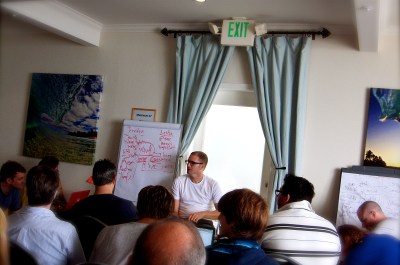
Last week I had the opportunity to sit in what essentially amounts to a living room with 47 other leaders and Rob Bell. And for two full days (9 am to 9 pm) we talked about leadership, creativity, spiral dynamics, how to handle criticism, exegesis, raising kids, the eucharist, and surfing (along with various other topics). It was all over the place, but completely awesome.

I really appreciated the way Rob ended our time: he served us all communion. He talked about how the word eucharist can mean “good gift.” That Jesus’ body, broken and poured out, is God’s good gift to us. As leaders we almost always are serving other people (sometimes literally serving others the eucharist), and that we need to be put back together and poured back into. And that is what those two days were all about.

I needed that.

There are a million other things to say about this time (I have over 20 pages of notes), but I’ll leave you with these three:

  1. I appreciate Rob because he doesn’t hold back. It’s immensely clear that he throws himself completely into whatever it is that grabs him…whether that’s searching for the perfect taco or preparing for a talk, he goes all out.
  2. I appreciate Rob because he knows the ups and downs of pastoral leadership. He has many metaphors to describe it too (i.e. pastors are not “ecclesiastical punching bags”)! He gets it and he wants to pastor pastors through the ups and downs as much as possible.
  3. I appreciate Rob because he walks the line between humility and confidence with a great deal of grace. He’s a totally normal dude. He makes his kids breakfast everyday and drives them to school. He remembered someone at the conference because of a conversation they had after a tour stop in 2008. He also was named one of TIME’s 100 most important people in 2011. He’s very down-to-earth, but he knows he has a voice and he is confident in what he has to say.

I am extremely grateful I had the opportunity to be a part of this experience…it was life giving and timely. Good for my soul!

Layers (RePost)

I think that if you do life right you spend your first 25 years accumulating layers, the next 25 peeling those layers away, and the last however many years you live just letting it all hang out.

This is an oversimplification, but I do think the central idea is true: maturity is all about delayering.

Maybe another way of putting it is this: I think we equate maturity with more…more patience, more kindness, more joy, more love.

But I would argue maturity is about less busyness, less attatchment to things, less clutter (physically and spiritually).

I can sense already some push back to this “negative” stance (sounds too buddhist!). But I think scripture supports this (for example and foranother) and I know my experience certainly does.

The delayering for me began with marriage (in my humble opinion it has to start here, if it hasn’t already, or you are in for a short marriage). Then it became vocational. Then it started to affect the way i dress, which is pretty superficial…

…but I can feel it getting deeper and deeper. Soul delayering. I know that I am in the middle of a moment of significance in my story but I can’t put my finger on what that means quite yet. I do know that it feels like getting rid of layers. That I am identifying less and less with external sub-cultures and other markers, and more and more with inner convictions.

Sthere’s that.