The Genius of the Red Solo Cup

You’ve probably been to a party with red solo cups. You know the drill. Everyone has the same color cup so you write your name on yours,
or you never put your cup down,
or you go through about 10 cups during the party
because you don’t want to pick up the wrong one
(who knows what’s in there!).

The red solo cup.

A symbol for college parties, but also a symbol of conformity. Why don’t we get more creative with cups at these parties? Is it because we just want to blend in, we don’t want people to know what or how much we’ve been drinking, we just want to be part of the crowd?

I find this fascinating.

There are no red solo cups in the Kingdom of Heaven. “LORD, you have assigned me my portion and my cup” (Psalm 16:5).

No, everyone has their own cup, a cup that reflects who they are and how they’ve been beautifully and wonderfully made.

The Kingdom of Heaven is not one of conformity and monochrome monotony.

It is full of color
and life
and creativity
and expression,
where you are fully you.

This is the world we are invited to step into. Remember this the next time you fill your red solo cup.

The Simple Joy of Splashing in the Bath

I can trend in the direction of cynicism. There are all sorts of reasons to be skeptical,photo
to be aloof,
to stay removed,
and to avoid getting to emotionally attached to anything.

The world works against joy:
trains don’t arrive on time
and people cut you off
and employees at businesses treat you poorly and have bad attitudes
and other people talk smack about “those” people
and your neighbors are annoying
and your co-workers are frustrating
and I’m just getting started.

I could go on.

But there is a better way to live. Cynicism is just too easy.

My daughter consistently reminds me that the world is actually an amazing and endlessly fascinating place.

There are so many things to see
and discover
and touch
and taste
and feel
and eat.

This weekend we discovered the joy of splashing in the bath.

Such a simple joy. Just flailing arms
and water all over the floor
and giggles.

It was beautiful.

There are so many things to wonder at.
Sunsets and sunrises.
A good meal.
Sitting around and talking
and laughing
and remembering.

I could go on.

Here’s to the simple joy of splashing in the bath.

Wholehearted

What would it look like to get to the end of a busy season, a semester, a year…a life even, and have more and more to give than ever before?

Caleb is my go-to for leadership inspiration…the image of him as an 85-year-old man still rearing to go, still ready to fight, is awesome.

Throughout his whole story we read the mantra: “Caleb followed God wholeheartedly.”

I’ve blogged about Caleb before, but I am always convicted by his example. Never falling into bitterness or cynicism Caleb’s enthusiasm only grows and strengthens with time. He seems to have more and more to give.

I want to be like that. I want to be wholehearted.

Thanks Marina

On Friday’s I get to hang out with this beautiful little girl.

HPIM6510 HPIM6511

I don’t get work done on Fridays. Maybe a few emails, maybe a couple of minutes on this project or that assignment.

But, for the most part, normal work ceases.

However, Friday is not a sabbath.

It’s still work.

But in some ways, Fridays work like a sabbath. I have to let go of my work…of being productive…of getting everything crossed off my list.

Because there’s always more to be done…always another meeting to take…always another project to tackle.

So, thank you Marina, for helping to slow me down.

A Quick Thought on Bay Area Sports Figures

Living on the east coast I experience various questions and assumptions about California. In the last couple of years my beloved Bay Area sports teams have been pretty good, and so these questions and assumptions have risen to the surface more often.

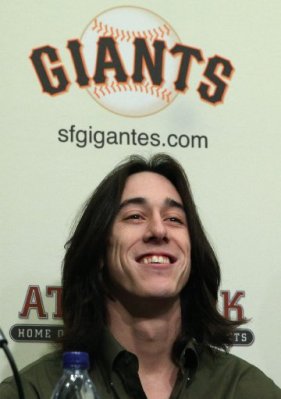
When it comes to Bay Area sports figures no one comes up more often in conversation than Tim Lincecum. Timmy (even though he hails from Seattle) seems to embody a primal image of the “Californian”. He fits the “dude/bro/stoked/gnarly/chill/man” stereotype.

Because he looks like this:

lincycy2

Trying to explain California to people who have never been there and only know MTV and sports is difficult. They are missing something important. Something I learned when I was teaching kids math in the state’s public schools.

Most of the kids I taught look like this:

bilde

sergio-romo-crop

I hope that Colin and Sergio continue to perform well on the field, but I also hope that they take their public image seriously. There are a lot of kids in California who will look up to these guys.

Pay attention, rest of the world, these guys represent California way more than Tim Lincecum.

And that’s a good thing.

Cities of Refuge

In Joshua 20 and Deuteronomy we learn of a lesser  Old Testament idea: Cities of Refuge. Three cities where someone who has killed someone accidentally can go to avoid retribution.

On the surface this might seem odd: why set up a whole city to respond to this one issue? Were there other things you could escape from in a City of Refuge?

For one who found themselves in the predicament of accidentally killing a neighbor I am sure a City of Refuge was a beautiful symbol of grace and rescue.

On a deeper level, I think these cities served another purpose: the performance of alternative story.

Culture dictated vengeance and more violence. Refuge ended the cycle. These cities said: “you don’t have to live like that.”

May our churches, our community groups, our gatherings, our presence in neighborhoods be “cities of refuge.” Reminders that dictates of culture do not apply here…vengeance, hate, cycles of dysfunction…they can end.

Faith and Doubt

There is a sort of faith

That is too small to comprehend

How high and wide and deep and long are the mysteries

Of a love that surpasses our ability to know.

And there is a sort of doubt

That is too confident

To admit that there is more to the world

Than what we can see and touch and prove and measure.

Beyond faith

And doubt

There is wisdom.

(inspired by our community group’s convo on james 1)

To Remember

What do you do to remember?

Do you write stuff down, do you make something, do you take a picture (do you tweet that pic, do you instagram it, do you post it on facebook)?

In the book of Joshua, Joshua promises his people “the LORD will do amazing things among you” (3:5). As a leader, this is a bold statement. Joshua doesn’t say the LORD will do some cool things, or some interesting things…he says “amazing things“.

And He does. He stops a rushing river, allowing all His people to enter their promised land on dry ground.

Joshua immediately decides that they need to do something to remember this. So they make a pile of rocks.

Why?

Because we live in a world high on promises and low on delivery, and so it can become easy to be jaded or cynical when a leader says: expect something amazing.

Joshua doesn’t want them to forget.

You can’t argue with a pile of rocks.

Meditate On It

In Joshua 1 we discover a people in transition. The people of Israel mourn the loss of their fearless leader, Moses, and look to Joshua to take his place. All this before, finally, entering the land they had been promised hundreds of year prior. A land filled with enemies.

Joshua 1 is great for leaders in times of transitions. It’s a rah-rah speech, and the wonderful promise of God (“I will be with you”) is repeated at least three times.

Which is very encouraging for us at any time, but especially during times of challenge. Times when it feels like we are going into enemy land. This can feel like all the time in Boston.

The connecting thought, and really the central premise, of Joshua 1 is found in verse 8:

“Keep this Book of the Law always on your lips; meditate on it day and night, so that you may be careful to do everything written in it. Then you will be prosperous and successful.”

Sometimes I read Joshua 1 and think I have to work up some amazing courage and fearlessness.

No. Meditate on the word.

Don’t Go Back

Consider this:

They said to Moses, “Was it because there were no graves in Egypt that you brought us to the desert to die? What have you done to us by bringing us out of Egypt? Didn’t we say to you in Egypt, ‘Leave us alone; let us serve the Egyptians’? It would have been better for us to serve the Egyptians than to die in the desert!” – Exodus 14:11-12

Why is the Lord bringing us to this land only to let us fall by the sword? Our wives and children will be taken as plunder. Wouldn’t it be better for us to go back to Egypt?”  And they said to each other, “We should choose a leader and go back to Egypt.” – Numbers 14:3-4

During times of transition and uncertainty there is something within us that makes us want to go backwards. This is interesting, especially when you consider this:

  • Joshua Slocumb was a sailor in the late 19th century who was given a boat called “The Spray”. It was a run down boat that needed some love, so Joshua grabbed his axe, headed into the forest, cut down some trees and fashioned planks (by hand). He then rebuilt The Spray and sailed it around the world. By himself. He was 51 years old.
  • Sue Oldham decided it would be cool to swim to another country. So she conquered the English Channel, all 21 miles, in 16 hours. At the age of 64.
  • Bill Snyder was a good football coach who retired, got a stadium named after himself, and then came back several years later to have his most successful season in 2012. At 73. (I find this particularly encouraging since he is a college football coach).
  • Betty White, experiencing a career resurgence, hosted Saturday Night Live at the age of 88. It is, to date, the highest rated episode of SNL. She’s still going strong into her 90’s.

What is the point of all this? None of us is guaranteed a long life, but there is a really good chance you have not peaked yet. Your best years, your biggest adventure, your gnarliest risk might still be ahead of you.

Don’t go back Egypt now, it might be time to sail around the world!

I find this particularly helpful in my work with students, many of whom have been promised that college will be the best years of their lives. When college turns out to be the hardest years of their lives the reality can lead to frustration, to turmoil, and even depression. But that student might be years away from the pinnacle. They have plenty to look forward to.

Organizations can do the same thing. Remembering and reminiscing are important, but too often we become overly nostalgic about the “way it used to be.” Don’t go there! Your organization might be decades away from its heyday. And that’s ok.

Enjoy the moment. Celebrate where you’ve come from. But look forward to and anticipate the future because the best may still be to come!