Orthos

Today: a quick offshoot of the boring church conversation we started last month. There are typically two paths offered by most churches to help people figure out if they are doing the spiritual life “right”.

———-

On the one hand you have: orthodoxy. This is a very good word that can also be quite loaded, depending on what circles you are circling in. Orthodoxy is a term that feels inviolable: if I’m not orthodox then I’m a heretic, right? And there’s truth there, historically, and in the literal definitions of the terms.

For our purposes today, let’s focus on the second part of the word, the doxy. Belief. There is a heavily western elevation of Orthodoxy as the way. Again, I am not referring to the traditions and doctrines of Christian orthodoxy, but more to the idea that what matters most is what we believe. 

To paraphrase Jesus, it’s the idea that, yeah, we love God with all our heart, soul, mind, and strength, but mostly just with our minds. The mind is the most important part. The heart is deceitful, the soul is hard to define, so let’s get our minds right. We think, therefore we are. 

As a result, terms and ideas get labeled as orthodox and then one gets punished for daring to question it. And this is how you end up with: Conformity.

(PS. This is where fundamentalism lands, along with a variety of other camps. To use our quadrant the bottom half tends to be all about Doxy/Belief).

———-

On the other hand, you have orthopraxy. Praxis=action, or practice. Beliefs are important, but what we actually do is what matters. Impact the world, do stuff, make things happen. Matthew 25 kind of stuff. 

Orthopraxy can become just as judgy and mean as Orthodoxy. It can become a soft form of cancel culture: “Oh, you don’t care about this issue, you didn’t go to the protest, you aren’t serving in this way, you don’t like this kind of worship? You are obviously a sellout/hypocrite/poser/etc.” 

It should be very clear, I hope, that I am not attempting to negate doxy or praxy…we need both! But, they have both contributed to the stifling conformity in the church. 

———- 

And so I would like to help introduce a larger audience to an idea that I came across in Kevin VanHoozer’s fantastic work: The Drama of Doctrine. He coined the term: Orthokrisis. Right judgment or discernment.

We need to be careful about our beliefs and grounded in our actions, but we also need to be willing to name our filters. Beliefs and Actions are not developed in a vacuum. A lot of what we consider to be orthodoxy or othopraxy can be deeply conditioned by our culture, our political climate, our news/social media feeds, etc. 

In a future post I will attempt to define a better filter for our cultural moment, but for now, I want to leave you with the challenge of thinking through your own filters given this introduction to Orthokrisis.

How do you apply your beliefs and actions to your moment, context, neighborhood, family, job, and places of play?

My hope and prayer is that Orthokrisis helps expand our imaginations for what Orthodoxy and Orthopraxy might look like in our local contexts.

The Conformity Quadrant

Last week I wrote about how cultural pressure has led to a protectionist mindset in churches, leading to a boring conformity.

Let’s explore this a bit more. First, a disclaimer: I am a pastor, not a researcher. Most of what I share here is from experience. Other sites can give you the data and statistical analysis. But, I have been doing this for about 20 years, which simply means: I’ve seen some things. And so these are my observations.

In this moment of conformity, we have settled into four camps. (By we: I mean evangelicals, and I use this word here in the broadest possible sense. I will use it again in a moment in a slightly different fashion, to describe a sub-category, I apologize for the confusion that will ensue!)

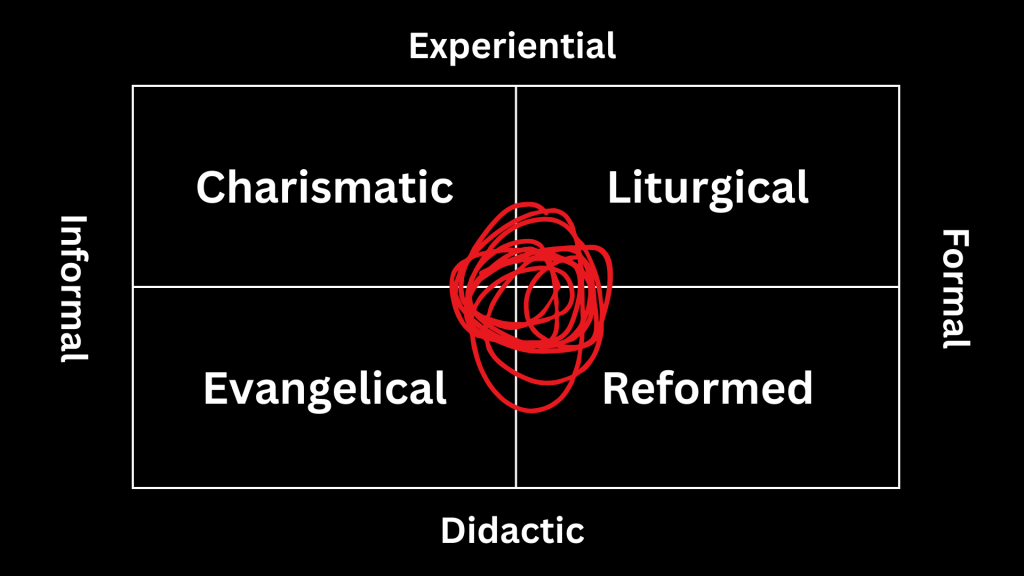
Here’s a handy chart!

And here’s a quick breakdown**: 

  • Liturgical churches
    • High structure (all churches have structure, but the high structure expression on this chart use structure as a feature: it’s part of their “thing”)
    • Strong experience (the liturgy is the driver for formation, not preaching)
    • Examples: some Presbyterian expressions, neo-Anglican, CRC, etc
  • Reformed churches
    • High structure (their structure is based on hierarchy rather than liturgy: in fact hierarchy is the organizing principle of life, from family and home, to church, to doctrine, etc)
    • Strong didactic (someone higher up in the hierarchy will tell you what to do)
    • Ex: Bethlehem Baptist (Piper), Grace Community (MacArthur)
  • evangelical churches
    • Low structure (structure is there, but it is for organizing ministry programs and building the organization, not a main feature. In fact, most non-denominational churches will downplay their structure, even though they might be HIGHLY organized)
    • Strong didactic (preaching is a primary feature, often the main vehicle for formation)
    • Ex: Saddleback, Willow Creek, etc
  • Charismatic churches
    • Low structure (similar ethos here to the evangelical churches)
    • Strong experience (here the experience is focused on worship, the Spirit, and prayer, rather than liturgy)
    • Ex: Hillsong, Elevation, etc

**Notes: this breakdown is pretty similar to John Mark Comer’s 4 gospels

This is a simplistic summary and I know practitioners of each would be pretty frustrated by my reductions. In real life, it’s more complicated and nuanced than this, we all get that (right?!).

Over my lifetime, there have been shifts of energy (and power) amongst these quadrants. In the 90’s the “evangelicals” were winning, in the late aughts and early 2010’s the neo-Reformed took over the discourse, and this decade the Charismatics are dominating. (More to say about all of this as we move forward.)

For now, the movement through the grid leads to a boring conformity and a lack of imagination. What I hope to point to, ultimately, is something like this…

…because what is going on in each quadrant is not “bad” per se, but the copy and paste mentality needs to go and be replaced by an integrative approach that recognizes the good gifts of different traditions, but reimagines them for specific contexts.

In my community (small college down in the middle of California), we have a LOT of coffee shops. We have a handful of Starbucks, a Peets, a popular Bay Area mini-chain, and a popular Sacramento shop that opened a store here (this is a common issue in Davis, we repeat cool Bay Area and Sacramento things rather than create our own).

I go to Pachamama. It’s one of the few truly local options (plus its model is really cool). My contention is that the church should be more like Pachamama than Starbucks, a local expression of Good News rather than a cut-and-paste copy.

Boring Church

One of the griefs of middle age is the sober realization that your youthful dreams of changing the world are probably not coming to fruition.

I know, I know: what a cynical and sad way to start! I used to roll my eyes at older leaders who said similar things to me when I was in my twenties and starting out on this leadership journey.

A couple decades ago I was certain my generation would figure it out. There was no way we would repeat the mistakes of our parents and grandparents and the future of the church would be glorious and awesome.

Nope, we are repeating the same mistakes over and over again.

—–

Ok, that was the dark opening to my relaunching of this blog: nothing has changed, nothing has gotten better. Woohoo!

On the lighter side of things: I am still full of hope. The church is still a beautiful force for good, and (for better or for worse) the central player in God’s mission to restore shalom. I love this work and our little kingdom outpost here in Davis, CA. 

But, we are not the generation to “figure it all out” and the next one after us will probably repeat a lot of our mistakes. I rage against the fact that there is nothing new under the sun, but find this truth liberating at the same time. It right-sizes my grandiosity.

And so, from that place (cynically hopeful??) I want to process some of the things I’ve learned, some of the things I see, and where I am finding hope these days. Thanks for reading!

——

Observation 1: The Church in 2024 is extremely boring.

Let’s define boring! According to the dictionary boring means: not interesting, tedious. Some synonyms include: repetitive and unimaginative. That last word is key because, and I want to be clear here, the opposite of boring is NOT entertainment. 

The answer is not a good show, but a holy imagination. Twenty years ago Alan Hirsh and Michael Frost wrote: “It is not too harsh a judgment to say that most people in the Western church simply cannot see beyond the Christendom mode they know so well.”

And, oooof, that is still true, even more so today than twenty years ago (imho)!

At the risk of being overly simplistic, here are two reasons why we’ve lost our imagination and settled for boring church.

First, outside the church, the church lost the culture wars. I know some people are still fighting, but these are the little battles that linger after the main war has ended. We are in a post-Christian world now and the church has been moved to the fringe. 

This is scary, and it breeds a circle-the-wagons/stop-taking-risks/keep-the-customers-happy mentality. I get it. There is a lot of pressure to maintain and a lot of fear of losing (people). But that fear is crippling and stifling. Nothing new happens because new might be too disruptive. 

Why disrupt when everything else feels in flux?!

Second, inside the church, churches have chosen pragmatism over imagination. There is a desperate searching for things that “work.” If church A is doing something that appears successful, let’s copy it, so that it works for us. Next thing you know, every church looks the same.

This is a failure of nerve and an abdication of responsibility

We are not robots, we are co-creators, shaping the future with God. We must reclaim imagination!

I will say, as a word of caution, daring to imagine a different future, and forging ahead into new territory is costly. I’ve been called some names, friends! But, God has not given us a spirit of fear, but one of power, love, and sound judgment. 

This is just beginning…more to come next week. For now, let’s stoke that holy imagination and start dreaming again about a different future. 

Scott McKnight on “Mission” #kingdom #church

“Kingdom mission is church mission, church mission is kingdom mission, and there is no kingdom mission that is not church mission…

Many see kingdom exclusively in utopian terms and the church in all its rugged messiness, so they toss dust in the eyes of anyone who gets the two too close. But this fails at the most basic level of exegesis. The kingdom in the New Testament is not just a future glory but a present rugged reality struggling toward that glorious future. That is, the kingdom is only partly realized; it is only inaugurated in the here and now. So the kingdom today is a rugged mess no less than the church is also a utopia…

It is easier to do [good deeds like build a well than get involved in a church] because it feels good, it resolves some social shame for all that we have, it creates a bonded and encapsulated experience, it is a momentary and at times condescending invasion of resources and energy, and it is all ramped up into ultimate legitimation by calling it kingdom work.

Not only that, it is good and right and noble and just. It is more glamorous to do social activism because building a local church is hard.

It [building the church] involves people who struggle with one another, it involves persuading others of the desires of your heart to help the homeless, it means caring for people where they are and not where you want them to be, it involves daily routines, and it only rarely leads to the highs of ‘short-term’ experiences.

But local church is what Jesus came to build, so the local church’s mission shapes kingdom mission.

from Kingdom Conspiracy (p. 96-97)

The Gift of Good Words

I am absolutely convinced, as an avid reader, that books find me more than I find them. They find me in all sorts of ways (Amazon’s crazy algorithms, word of mouth, browsing a good bookstore), but they are finding me a lot, these days, through the recommendations of my wife.

A book she shared with me that has been speaking to us in this time of moving and transition is Bittersweet by Shauna Niequist. The book is a meditation on change: change that comes through loss and pain and gaining and growing.

Her words have been a good gift to us.

Here’s some fun words about California:

I have a thing for California, possibly because the four years I lived there during college were the wildest and most disorienting years, punctuated by some of the sweetest moments in all my life. Possibly because California, both in its geography and its personality, is so many worlds away from the Midwest that just being there makes the world feel bigger. I love California for its otherness…

Amen.

Many of the life events she reflects on, miscarriage, parenting, leaving a church/church job, finding new community, moving “home,” are very similar to the big things we’ve been through in the last 3 years.

Sometimes there’s only so much processing you can do on your own, and you need someone else’s words to express what you’ve been through. Or, you just need to read and know that someone else has been through the same thing and felt the same things you’ve felt.

Anne Lamott says the best sermon is: “Me too.”

And in all the truthiness of that thought, Bittersweet has been the best kind of sermon for us at this season of life. I resonate deeply with this:

I wanted for this bittersweet season to be over. I felt so strongly…I’d be free to move into another season, one of life and celebration. But this is what I know: they’re the same thing, and that’s all there is. The most bittersweet season of my life so far is still life, still beautiful, still sparkling with celebration. There is no one or the other, as desperately as I want that to be true. This season wasn’t bittersweet. Life itself is bittersweet. There’s always life and death, always beauty and blood…Life after death…I’ll celebrate the resurrection of Christ with everything in me this year, pleading for a resurrection inside my own battered heart as well.

Some New Thoughts on Fundraising

One of the questions I get asked most often these days, usually right after “aren’t you glad you moved and miss than winter in Boston,” is something to the effect of: “how does it feel to not have to fundraise anymore?”

Actually it isn’t as much of a question as an indirect way of saying: “You’re life must be so much better now that you don’t have to fundraise.”

I really dislike this comment.

To begin with, I actually liked fundraising. It kept me in touch with a lot of people who I otherwise might not have stayed in contact with. It forced me to ask for help, which is not something I enjoy doing naturally. We experienced grace and generosity in ways we would never have otherwise. Fundraising created a community with friends near and far, a sustaining community, a community that also helped us find our new role.

Furthermore, just because I am not fundraising doesn’t mean we are free of financial risk. That’s the subtext for a lot of people: fundraising is crazy and risky, working at a church is safe and secure (and in many people’s minds lucrative).

I object to this line of thinking greatly. Yes, the realities of fundraising are quite different from the realities of a salary. But, a church salary, especially at an urban, inner city church, is no sure thing. This community took a risk in hiring me, and any small church pastor will tell you about weekly anxiety and uncertainty.

This is not to say that I don’t have critiques of fundraising or that there aren’t aspects of the process that I am glad to be free of. It’s just not quite what most people might expect.

A couple of critiques:

1) First, fundraising is exhausting. It is a never-ending process. But, while it is a grind, that’s not actually what I am referring to.

I had a supporter who is a professor at Fuller Seminary in the psychology department, and she’s been working on a big project on Young Life, looking into the effects of camp ministry on discipleship. In the process she met and talked at a lot of Young Life staff, hearing their stories and getting to know what their life is like.

She drew a conclusion: Young Life staff are stressed out and working well beyond their capacity.

You might assume this is because they work too many hours, play too many silly games, and spend several weeks of the year at camp. But, that’s not actually what is wearing them out.

According to the research my friend was doing, the stress came through the balancing of too many communities. A Young Life staff has the community of student’s they are investing in (usually at a school). Then they have their co-workers and other area staff. They are building relationships with the school administrators. They have their church circles and their neighbors. They have other friends. If they are married, they are also balancing those “worlds.”

And then they have this group of people called “supporters,” 100-300 people they are regularly in contact with about prayer requests and financial support.

Now, as I mentioned earlier this is a beautiful thing, to have so many people supporting you. But, it is exhausting too.

In Boston we had our Sojourn team, our campus groups, our church groups, our friends in Boston, Amy’s work, our neighbors, our extended family around the country, other friends around the country, and then our support team. Some of those overlapped, but many did not. It’s no wonder we struggled with getting to know our neighbors.

One thing we already appreciate about this new chapter is that there are fewer circles to manage and we are freer to interact in each circle. We are more present than we ever were in Boston.

2) Second, I struggle with the unfortunate reality that fundraising is far too often used as THE vetting tool for mission work. In other words, if you can fundraise, you can do the work.

Unfortunately, there are a lot of great missionaries, campus ministers, young life leaders, etc, who never get to do what they were clearly created to do because they don’t have the network for fundraising.

Now, for some people this is a real obedience issue: there are some folks who are lazy, undisciplined, afraid or unwilling to ask, or  who lack the training to hit their fundraising goals. These folks squander the opportunity and gift in front of them.

But, for every one of those folks, there are two great missionaries who walk away because, for whatever reason, they can’t fundraise enough money. I think in particular of the college graduate who has to pay off student loans, or the first-generation immigrant student who simply doesn’t have the resources in their networks, or the new Christian who doesn’t have the church experience/community.

We make it very difficult for these people to participate if fundraising is the vetting issue.

Furthermore, there are some people who are great at fundraising who have no business being campus ministers or missionaries because of character issues or gifting.

3) My final thought is that fundraising can make the relationship between the organization and its employees difficult at times. If funds are not properly accounted for and kept track of fastidiously, it can breed resentment. Especially if some people are essentially forced into carrying the load for a time (or indefinitely).

I won’t go into details, but when I started fundraising I kept very detailed records of what I brought in and took out (no one else was doing this for me when I started and I am grateful we brought someone in to do this for us about two years into my time with the organization).

That decision turned out to be prescient, because there came a day when a significant chunk of money of that money disappeared. If not for my records I’m not sure what we would have done. For the record, this story is less about losing money and more of an example of one way that fundraising can lead to resentment and frustration.

This is an interesting phenomenon because one of the benefits of fundraising is the regular experience of grace and miraculous provision. It is amazing how quickly that turns when there is “miraculous” disappearing of funds. It tested my understanding of grace to be sure.

Having said all that I did enjoy fundraising. I got choked up writing my final thank you notes and I miss the connection and bonding that fundraising brings.

But I also feel free in a lot ways that seem healthy.

To my friends that continue to fundraise: keep on it faithful friends!

To the organizations that require fundraising: may you be full of integrity and serve the best interests of your employees.

To the rest of us: may we be generous to those who ask for our partnership.

What I Get To Do

One of the weirder parts of our transition to California is that while we had at least three opportunities to share about what we were going to do in a public setting, we never got the chance to actually do it.*

So, I thought I’d take a post to share a little bit about what I/we get to do here in Oakland.

Broadly:

I get to help our new church build a culture of doing justice, loving mercy, and walking humbly in our neighborhood and city.
I get to pastor and shepherd and teach.
I get to learn and serve alongside a diverse group of people. I mean crazy diverse. In every possible way. Google employees and homeless folks, old and young, parents and kids and single folks, and on and it goes.

Specifically:

Amy and I are facilitating/teaching a class for 8 engaged/recently married couples and we are having a blast preparing for and interacting with this group.
I’ve been able to preach three times already.
I’m getting to build needed systems and structures.
I’m meeting with and coaching small group leaders.
I’m helping coach our Pais interns.
I get to have conversations with people who have serious questions about God.
I get to disciple.
I get to lead.

And:

I get to be home 5 or 6 times a week to help put our kids to bed.
I get to ride my bike to work every day.
I get a sabbath.
I get to live in the most diverse city in the country, wear shorts most of the time, and hug Buster Posey (ok, that last part is a lie, but IT COULD HAPPEN).

I don’t have words to express the gratitude I feel on a daily basis.

Thank you Jesus.

*I’ve written about some personal lesson I’ve learned about transitions, but I hope to write a post soon on the leadership lessons I learned during this season. 

Listening to Your Guts and Church

“There can be as much value in the blink of an eye as in months of rational analysis.” ― Malcolm Gladwell, Blink

I strongly believe in the weightiness of the “blink test” when it comes to churches. I know we need to pray and think and not commit lightly to a local community. But, most of the time we walk into a gathering of people and we pick up things at a very deep, gut, intuitive level:

Is this a safe place? Is this a joyful place? Is there life here?

Or

Is this a dangerous place? A cynical place? Will the life get sucked out of me here?

We don’t know everything that will happen in a particular place. We don’t know who might wound us, or who might turn out to be a life-long friend. That’s all part of the adventure of community. But, again, I think we know some things just by walking in the door.

This weekend I got to go to a church and I knew, without really “knowing”, there’s a lot of joy here, a lot of life. And, nothing that happened the rest of the day did anything but encourage that knowing.

Let me say it again: be prayerful and thoughtful about church and choosing community.

I do wonder, though, if our cultural propensity towards making rational decisions has desensitized our ability to be in tune with our guts, with that still, small voice that might actually be speaking more powerfully than pros and cons lists.

So pray and trust your gut.

Eugene Peterson on Pastoring and Other Amazingness

From this great interview:

The one thing I think is at the root of a lot of pastors’ restlessness and dissatisfaction is impatience. They think if they get the right system, the right programs, the right place, the right location, the right demographics, it’ll be a snap. And for some people it is: if you’re a good actor, if you have a big smile, if you are an extrovert. In some ways, a religious crowd is the easiest crowd to gather in the world. Our country’s full of examples of that. But for most, pastoring is a very ordinary way to live. And it is difficult in many ways because your time is not your own, for the most part, and the whole culture is against you. This consumer culture, people grow up determining what they want to do by what they can consume. And the Christian gospel is just quite the opposite of that. And people don’t know that. And pastors don’t know that when they start out. We’ve got a whole culture that is programmed to please people, telling them what they want.  And if you do that, you might end up with a big church, but you won’t be a pastor.

Advice to young people looking for authentic church:

Go to the nearest smallest church and commit yourself to being there for 6 months. If it doesn’t work out, find somewhere else. But don’t look for programs, don’t look for entertainment, and don’t look for a great preacher. A Christian congregation is not a glamorous place, not a romantic place. That’s what I always told people. If people were leaving my congregation to go to another place of work, I’d say, “The smallest church, the closest church, and stay there for 6 months.” Sometimes it doesn’t work. Some pastors are just incompetent. And some are flat out bad. So I don’t think that’s the answer to everything, but it’s a better place to start than going to the one with all the programs, the glitz, all that stuff.