Our Feelings About Church

Over the weekend Rachel Held Evans published a blog post about how Millennials are leaving the church. Anyone doing ministry with college students or young adults saw this post, yawned, and went back to making disciples of the millennials who are leaving the church.

Other people got all fired up about it. I saw lots of facebook posts/tweets either lauding the article or worrying about her conclusions.

An observation: nothing Evans wrote about is new. McLaren wrote about this in 2000, as did Eddie Gibbs. No one has written more insightfully about this phenomenon than Christian Smith and Kenda Dean (my favorite). It’s been David Kinnamen’s life work.

Evans has received some push back, and some of it has been pretty good. See this and this.

I don’t have much more to add to the conversation, especially after Jonathan Fitzgerald went and posted this today. But, if there is something that stands out to me about millennials, it is best captured by recounting a scene from the greatest movie of all time: High Fidelity.

High Fidelity follows the story of Rob, a music snob who spends his time running a record store, making top 5 lists for everything under the sun, and trying to figure out why he’s never found the love of his life.

At the end of the film Rob reveals to his girlfriend that he is producing an album for some local skate-punks. His girlfriend is proud of him: “Rob, the professional critic, is finally putting something out there in the world.”

If there is something unique about millennials it just might be this: we’re a generation of professional critics. There is no shortage of outlets these days for people to share their opinions, to let the world know what we like and don’t like, what we need and hate, what we want to get rid of and what we want.

But, as Fitzgerald points out, talking (expressing our endless opinions) doesn’t matter as much as action.

Rob undergoes a transformation: critic to creator, and that is what is needed in the church today. Not more opinions, ideas, blog posts, or books.

If I had one creator for every five critics we’d change a whole lot.
Dedication

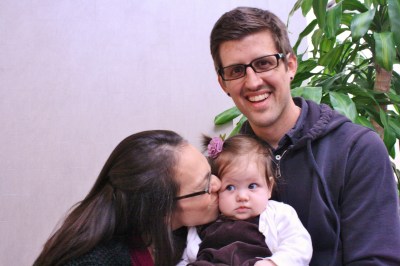
Lost in all the craziness of the last week was a beautiful moment we were able to participate in on Sunday (a week ago, which feels like a million years past now). We dedicated Marina at REUNION (our church partner and home church). I’ve always had mixed feelings about these moments, but what I appreciate about it the most is the love shown to us by our community and the reminder (and tangible practice/expression) of the truth that in the church we raise children as a community, not simply as individual parents.

Now for the cute pics:

IMG_5559 IMG_5582 IMG_5610

Cities of Refuge

In Joshua 20 and Deuteronomy we learn of a lesser  Old Testament idea: Cities of Refuge. Three cities where someone who has killed someone accidentally can go to avoid retribution.

On the surface this might seem odd: why set up a whole city to respond to this one issue? Were there other things you could escape from in a City of Refuge?

For one who found themselves in the predicament of accidentally killing a neighbor I am sure a City of Refuge was a beautiful symbol of grace and rescue.

On a deeper level, I think these cities served another purpose: the performance of alternative story.

Culture dictated vengeance and more violence. Refuge ended the cycle. These cities said: “you don’t have to live like that.”

May our churches, our community groups, our gatherings, our presence in neighborhoods be “cities of refuge.” Reminders that dictates of culture do not apply here…vengeance, hate, cycles of dysfunction…they can end.

Experience, Women in the Church, Philosophy, and Sweeps

  1. Guy Chmieleski wrote a great post on 15 things he’s learned in 15 years of campus ministry
  2. Millennials buy a lot of books!
  3. Q&A with Scot McKnight on Barna research regarding women’s role, women in the church, women in leadership
  4. BU prof Stephen Prothero on the difference between Christianity and Ayn Rand’s philosophy
  5. Oh, and the Giants SWEEP the Dodgers!

Review: Adventures in Churchland

I had two extremely formative experiences as a college student. My involvement with campus ministry through the InterVarsity chapter at Pacific forever altered the trajectory of my life. That is where Jesus found me and got a hold of my life.

The other experience(s) occurred in the form a monthly (sometimes more frequent) pilgrimage over the hill to Santa Cruz to a place called Graceland. Graceland started off as Santa Cruz Bible Church’s college and young adult ministry, then became a “church within a church,” and then eventually the leadership launched out on their own.

InterVarsity gave me the space to explore Jesus and my first halting attempts at leadership and ministry, and Graceland sparked my imagination for what a church could look like.

In particular, Dan Kimball, the lead pastor, taught interesting sermons, had interesting hair, and new all of the bands that I liked (back when I was a music snob). He is also an introvert and a deep thinker who wears black jeans all the time and his example was extremely helpful to me at that point in my life and journey towards full-time ministry.

For the last ten years I have read his books and blog and followed the Vintage Faith story from a distance. His most recent work is also his most personal: Adventures in Churchland. Dan has written an apologetic for the church, something desperately needed in a time when the church fails to capture the imaginations of so many in our culture.

Dan tells some hilarious stories as he outlines his personal journey from totally secular rocker to lead pastor and church apologist. He also spends a good part of the middle of the book reframing a couple of popular misconceptions about the church. Both are strong aspects of the book.

But where Dan really hits his stride is near the end, where he invites us to fully commit to this messy, beautiful thing called church. He compares the church to a mosh pit, this thing that is supposed to be fun and passionate but all too often leads to cuts and bruises. When this happens to us we almost always bail, in search of something better, more perfect. Instead of searching for perfection we should ask: “What mess will I choose to be in? And even more important, How might God use me to help clean up this mess?”

Finally, Dan describes individuals as God’s poema: a work of art, a work of a master craftsman. This individual work only becomes complete when part of a whole. “Without your contribution, the church is missing something that only you can bring.

Which is exactly right: sometimes we fail to get involved out of fear (this might hurt me), sometimes we refuse to get involved (because of a bad experience), sometimes we hold back (if I get rejected at least I didn’t give my best), and in each case everyone loses.

Everyone wins though when we lay down our agendas and roll up our sleeves and join in with God and others in the work he is doing. Dan’s journey from churchland to graceland is a beautiful story and I hope many people rediscover the good news that comes through being involved in a local church as a result of reading this book.

Organized? Religion

Some good thoughts from Dan Kimball on “organized” religion (more specifically churches):

“What makes the difference between healthy and destructive organization is what you are organizing for. When the church organizes around the biblical mission that Jesus gave his followers to share his good news of hope and forgiveness with people and lovingly encourage them in their desire to know Jesus, this leads to healthy organization…There’s too much need in the world not to be part of the organized church.