An Excursus and Two Side Notes (a great title)

Does God move us or do we move God? I will come back to the issue of the boring conformity (see last 2 posts) that has settled on American church culture in some of the next posts. Today, though, I wanted to address an under-the-surface issue that is a subtle (but extremely influential) driver of conformity.

There is a theological undercurrent in many churches that originates from a similar root idea, even if those churches come from wildly different traditions.

The root idea is that God is essentially inaccessible (off somewhere else doing his thing), and so we need to do something to get God’s attention. To answer the opening question: we must move to get God to move.

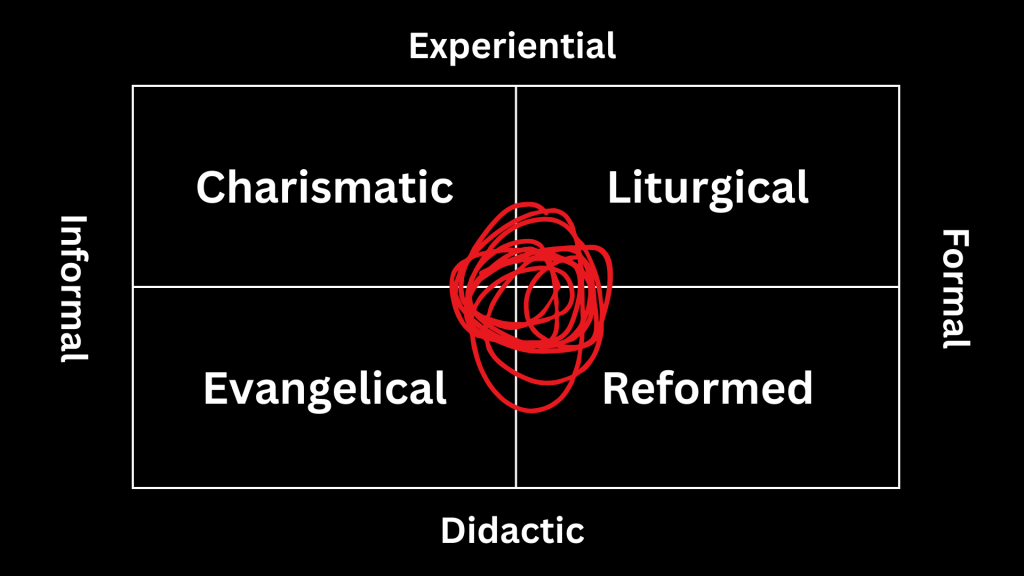
From my quadrant I want to pick on Charismatic (high experience/informal) and Reformed (high didactic/formal) churches for a moment (in no small part because they are opposites, at least according to my diagram, but also because true practitioners of each would be scandalized at being lumped together 😀…so this will be fun).

For Charismatics, there is a strong emphasis placed on worship and prayer (this is good!). But, the subtle (or not so subtle) teaching here is that YOU (me/we/people/etc) need to worship and pray really hard to get this inaccessible god to show up and do something cool. 

[[Side Note: much has been written about the charismatic take over of worship songs. This article and this book and this book are great examples. One quote from the article: “Adam Perez said the four most influential megachurches come from the charismatic tradition of Protestant churches. All of them, he said, have a spirituality that believes God becomes present in a ‘meaningful and powerful way’ when the congregation sings a particular style of worship song.”

He goes on to say (and this is sobering): “The industry itself becomes this invisible hand,” he said. “We don’t name the theology of praise and worship — we just assume it. And we use this kind of song repertoire to reinforce it.”

That little phrase “we just assume it” contains multitudes. Conformity flourishes in the soil of unexamined reality.]]

While there is a lot to be said about all of that, take note of this statement again: God becomes present in a meaningful and powerful way when the congregation sings. We have to move to get God to move.

For Reformed folks (who are snorting their coffee right now in outrage over this comparison): we have a very different presentation, but a very similar process.

In Reformed circles one must doctrine correctly, think correctly, study and teach the Bible correctly, obey correctly, submit correctly (you get the idea) and then God will be pleased with us and move (see: “right doctrine leads to right living”, the title of any number of sermons from Titus).

We’re still stuck with “we move to get God to move.”

To cut to the chase, this is formulaic spirituality and the only way out is relational spirituality. (PS. formulaic thinking ultimately leads to conformity).

[[Second side note: This is one of the best, and most important, books I have read in the last five years and it walks a beautiful line of being technical and accessible while making a clear case: we are wired for relationships. Another excellent resource would be the collected works of Eugene Peterson. Start here.]]

In a relational theological paradigm (based on the doctrine of the trinity), we are invited into the community of God by God through God. God is the prime mover and initiator. 

But (and this is important), the initiated movement is towards relationship. Relationships have give and take. God is already here and moving and he wants us to join in! To participate.

There are a lot of people who are genuinely and earnestly worshiping and learning doctrine (good things) hoping God will show up, meanwhile God is already there doing stuff wondering if any of these worshipping/doctriners will join the party!

Sort of like this

Part of my thesis in these posts is that we have a deeper problem than “youtube and instagram are ruining the church.” The problem is both theological and practical, and we’ll get into that more next time… 

The Conformity Quadrant

Last week I wrote about how cultural pressure has led to a protectionist mindset in churches, leading to a boring conformity.

Let’s explore this a bit more. First, a disclaimer: I am a pastor, not a researcher. Most of what I share here is from experience. Other sites can give you the data and statistical analysis. But, I have been doing this for about 20 years, which simply means: I’ve seen some things. And so these are my observations.

In this moment of conformity, we have settled into four camps. (By we: I mean evangelicals, and I use this word here in the broadest possible sense. I will use it again in a moment in a slightly different fashion, to describe a sub-category, I apologize for the confusion that will ensue!)

Here’s a handy chart!

And here’s a quick breakdown**: 

  • Liturgical churches
    • High structure (all churches have structure, but the high structure expression on this chart use structure as a feature: it’s part of their “thing”)
    • Strong experience (the liturgy is the driver for formation, not preaching)
    • Examples: some Presbyterian expressions, neo-Anglican, CRC, etc
  • Reformed churches
    • High structure (their structure is based on hierarchy rather than liturgy: in fact hierarchy is the organizing principle of life, from family and home, to church, to doctrine, etc)
    • Strong didactic (someone higher up in the hierarchy will tell you what to do)
    • Ex: Bethlehem Baptist (Piper), Grace Community (MacArthur)
  • evangelical churches
    • Low structure (structure is there, but it is for organizing ministry programs and building the organization, not a main feature. In fact, most non-denominational churches will downplay their structure, even though they might be HIGHLY organized)
    • Strong didactic (preaching is a primary feature, often the main vehicle for formation)
    • Ex: Saddleback, Willow Creek, etc
  • Charismatic churches
    • Low structure (similar ethos here to the evangelical churches)
    • Strong experience (here the experience is focused on worship, the Spirit, and prayer, rather than liturgy)
    • Ex: Hillsong, Elevation, etc

**Notes: this breakdown is pretty similar to John Mark Comer’s 4 gospels

This is a simplistic summary and I know practitioners of each would be pretty frustrated by my reductions. In real life, it’s more complicated and nuanced than this, we all get that (right?!).

Over my lifetime, there have been shifts of energy (and power) amongst these quadrants. In the 90’s the “evangelicals” were winning, in the late aughts and early 2010’s the neo-Reformed took over the discourse, and this decade the Charismatics are dominating. (More to say about all of this as we move forward.)

For now, the movement through the grid leads to a boring conformity and a lack of imagination. What I hope to point to, ultimately, is something like this…

…because what is going on in each quadrant is not “bad” per se, but the copy and paste mentality needs to go and be replaced by an integrative approach that recognizes the good gifts of different traditions, but reimagines them for specific contexts.

In my community (small college down in the middle of California), we have a LOT of coffee shops. We have a handful of Starbucks, a Peets, a popular Bay Area mini-chain, and a popular Sacramento shop that opened a store here (this is a common issue in Davis, we repeat cool Bay Area and Sacramento things rather than create our own).

I go to Pachamama. It’s one of the few truly local options (plus its model is really cool). My contention is that the church should be more like Pachamama than Starbucks, a local expression of Good News rather than a cut-and-paste copy.

The Genius of the Red Solo Cup

You’ve probably been to a party with red solo cups. You know the drill. Everyone has the same color cup so you write your name on yours,
or you never put your cup down,
or you go through about 10 cups during the party
because you don’t want to pick up the wrong one
(who knows what’s in there!).

The red solo cup.

A symbol for college parties, but also a symbol of conformity. Why don’t we get more creative with cups at these parties? Is it because we just want to blend in, we don’t want people to know what or how much we’ve been drinking, we just want to be part of the crowd?

I find this fascinating.

There are no red solo cups in the Kingdom of Heaven. “LORD, you have assigned me my portion and my cup” (Psalm 16:5).

No, everyone has their own cup, a cup that reflects who they are and how they’ve been beautifully and wonderfully made.

The Kingdom of Heaven is not one of conformity and monochrome monotony.

It is full of color
and life
and creativity
and expression,
where you are fully you.

This is the world we are invited to step into. Remember this the next time you fill your red solo cup.