Resurrection (Thoughts on Teaching and 35 Weeks of Luke)

This past Sunday our church partner, [REUNION], wrapped up a 35 week series on the book of Luke. It was long, but fruitful journey. I had the privilege of teaching 5 or 6 of those weeks. Most recently, week 34 to be exact, I got to speak on the resurrection.

Now, in some ways this is a home run for preachers…who doesn’t get excited to teach the resurrection?! On the other hand, there is a good amount of fear and trembling that goes along with the subject matter. What if the skies don’t open up? What if people shrug their shoulders and say “that was nice”? What if no one is moved?

This is not meant to be a critique of sermons or preachers, but as I was preparing I knew we needed a story. As it turned out there was a great story in our community that couldn’t have dovetailed any more perfectly.

Nancy told her story and she told it well, and probably the most important thing I said all day, and the thing people likely remember the most, was “that’s the power of the resurrection” after she had finished.

We need good teaching and people who can sermonize well, but how powerful and effective is a story? Amazing. And humbling from a teaching perspective. But, so important to the life of a community. Thank you Nancy!

*you can listen to it all here.
Some Thoughts on Generosity

I taught this weekend at [REUNION] Back Bay on Luke 16. Which is, like, one of the easiest passages in scripture to preach on. Just kidding. This section of the Good News According to Luke includes: the parable of the shrewd manager (is Jesus telling us to use money to buy friends?), some statements about faithfulness/self-justification/forcing ones way in to the Kingdom/the law never passing away/divorce, and the parable of Lazarus and the rich man (with its interesting view of the afterlife). Light stuff.

The big idea, as best I can make out, is this: use everything at your disposal (including your financial resources) to invest in things that last.

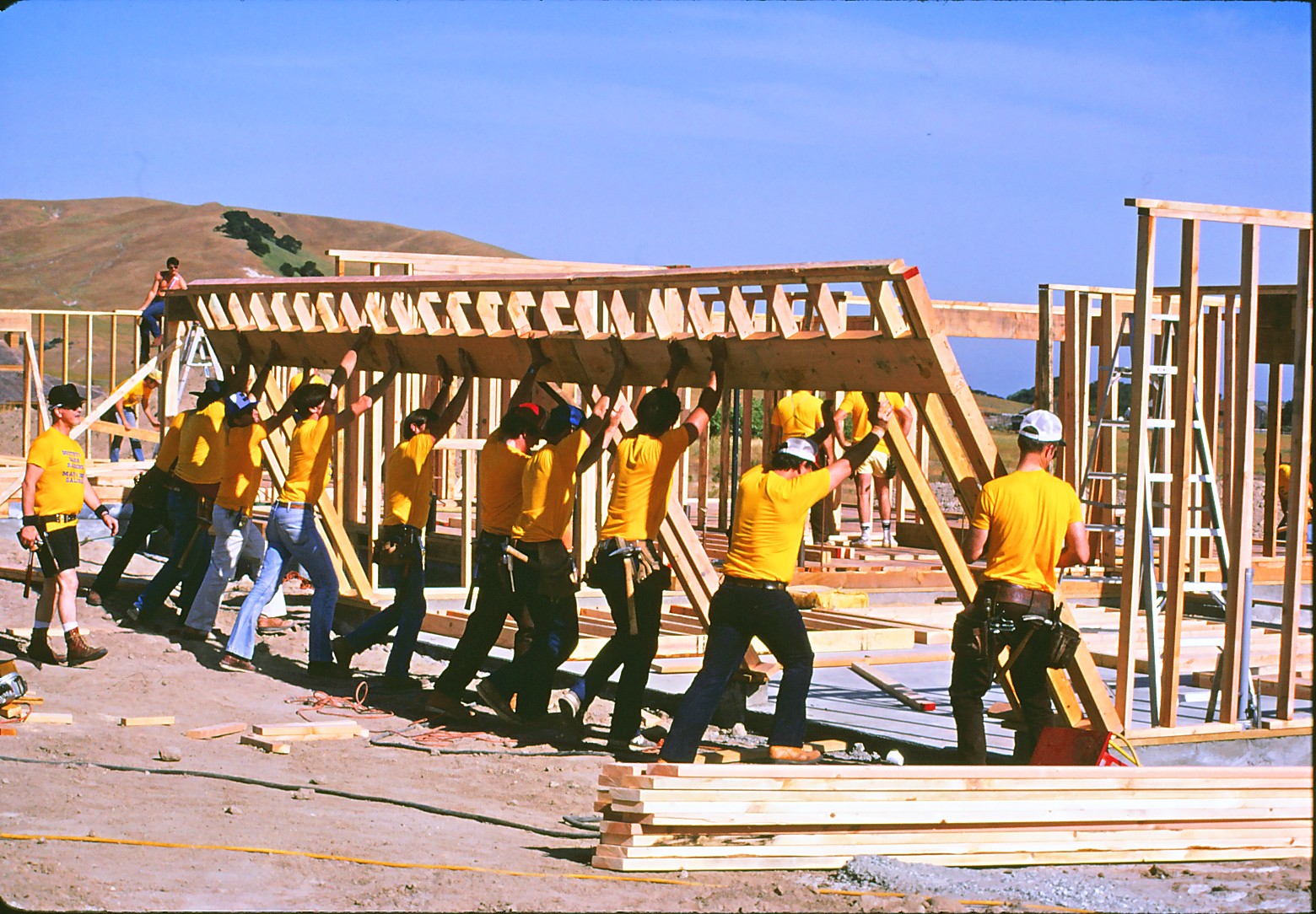
Which gave me an opportunity to share one of my favorite stories: the story of the house I grew up in. The short version goes like this: my parents move the fam to Salinas to plant a church…a contractor friend tells them to find a piece of land and he will build a house on it…they find some land…he builds the house!

The pinnacle moment of the story takes place on May 4th, 1985 when 70+ people wearing bright yellow “Boutry’s Barn Raising” t-shirts come pouring out of a bus to frame, roof, and side the entire house in one day.

It’s a great story. This is what it looks like to leverage your time, talents, resources, money, skills, networks, etc for the Kingdom.

But it’s an even better story when you (I) think about this: for the last 27 years my parents have always treated their home as a gift. They call it the “house that friends built.” And they have hosted thousands of people for every imaginable reason: community groups, newcomer desserts and lunches, discipleship, helping people in need, family gatherings, wedding rehearsal dinner parties, my college friends, missionaries, and the list could go on and on and on.

I think this is what Jesus is getting at in Luke 16 (albeit in an interesting way). And so, the story of my parents house, alongside Luke 16, is an inspiration, but also a challenge: am I using everything I’ve been entrusted with for the Kingdom?

Ordinary Time

I had the privilege to speak at REUNION this past Sunday on Luke 9:28-50. A lot is going on in the text, but I stumbled across something new (to me) in the process of preparing.

In the Catholic Church (and other “high” church traditions that use a liturgical calendar), the season, or period of time, in between Advent/Christmas and Lent/Easter is called:

Ordinary Time!

Which is awesome. Literally, this has some Latin root tied to the idea of counting a period of time, so it really refers to how many Sundays there are from Epiphany to Ash Wednesday.

It’s also grown to refer to a general down-swing in the Church Calendar. Advent and Lent are High (or Strong) seasons, and the time in between is Ordinary.

This is fascinating for a couple of reasons. First, there’s something to recognizing the natural rhythm of highs and lows in life and building that into the church calendar.

Second, as a “clergy” I respect the recognition that ministry in High seasons needs to be followed by a slower pace for a time (like summer is for Campus Ministers).

But I also think there’s a part of us that views High Seasons as better. We like the spectacular and the exciting but dread the mundane and the regular. Or, to use the Luke text as an example, we want to stay on the mountain and avoid the “real world” full of stubborn demons and quarrelsome people.

Now, check this out. Each season has a symbolic color…these can differ depending on traditions, but, the Catholic Church, for example, uses violet for Advent.

And it uses green for Ordinary Time.

Green which represents, rebirth, new life, even resurrection.

How awesome is that! Perhaps it’s the moments, the seasons, the periods of time that feel the most like drudgery, like a fight, that seem mundane and unspectacular that are the fertile ground for something new, for a resurrection.