

Last week I wrote about how cultural pressure has led to a protectionist mindset in churches, leading to a boring conformity.
Let’s explore this a bit more. First, a disclaimer: I am a pastor, not a researcher. Most of what I share here is from experience. Other sites can give you the data and statistical analysis. But, I have been doing this for about 20 years, which simply means: I’ve seen some things. And so these are my observations.
In this moment of conformity, we have settled into four camps. (By we: I mean evangelicals, and I use this word here in the broadest possible sense. I will use it again in a moment in a slightly different fashion, to describe a sub-category, I apologize for the confusion that will ensue!)
Here’s a handy chart!

And here’s a quick breakdown**:
- Liturgical churches
- High structure (all churches have structure, but the high structure expression on this chart use structure as a feature: it’s part of their “thing”)
- Strong experience (the liturgy is the driver for formation, not preaching)
- Examples: some Presbyterian expressions, neo-Anglican, CRC, etc
- Reformed churches
- High structure (their structure is based on hierarchy rather than liturgy: in fact hierarchy is the organizing principle of life, from family and home, to church, to doctrine, etc)
- Strong didactic (someone higher up in the hierarchy will tell you what to do)
- Ex: Bethlehem Baptist (Piper), Grace Community (MacArthur)
- evangelical churches
- Low structure (structure is there, but it is for organizing ministry programs and building the organization, not a main feature. In fact, most non-denominational churches will downplay their structure, even though they might be HIGHLY organized)
- Strong didactic (preaching is a primary feature, often the main vehicle for formation)
- Ex: Saddleback, Willow Creek, etc
- Charismatic churches
- Low structure (similar ethos here to the evangelical churches)
- Strong experience (here the experience is focused on worship, the Spirit, and prayer, rather than liturgy)
- Ex: Hillsong, Elevation, etc
**Notes: this breakdown is pretty similar to John Mark Comer’s 4 gospels
This is a simplistic summary and I know practitioners of each would be pretty frustrated by my reductions. In real life, it’s more complicated and nuanced than this, we all get that (right?!).
Over my lifetime, there have been shifts of energy (and power) amongst these quadrants. In the 90’s the “evangelicals” were winning, in the late aughts and early 2010’s the neo-Reformed took over the discourse, and this decade the Charismatics are dominating. (More to say about all of this as we move forward.)
For now, the movement through the grid leads to a boring conformity and a lack of imagination. What I hope to point to, ultimately, is something like this…
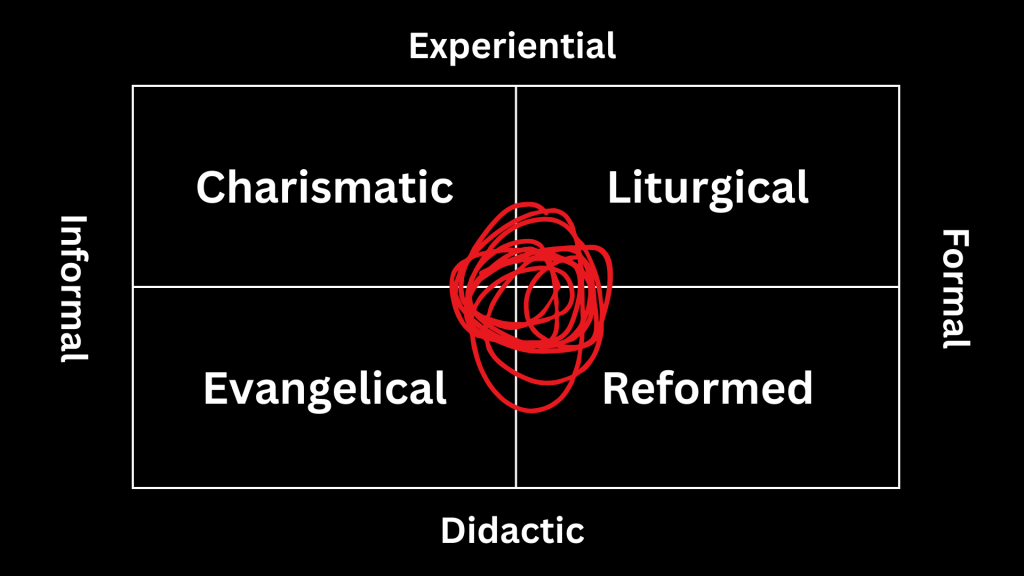
…because what is going on in each quadrant is not “bad” per se, but the copy and paste mentality needs to go and be replaced by an integrative approach that recognizes the good gifts of different traditions, but reimagines them for specific contexts.
In my community (small college down in the middle of California), we have a LOT of coffee shops. We have a handful of Starbucks, a Peets, a popular Bay Area mini-chain, and a popular Sacramento shop that opened a store here (this is a common issue in Davis, we repeat cool Bay Area and Sacramento things rather than create our own).
I go to Pachamama. It’s one of the few truly local options (plus its model is really cool). My contention is that the church should be more like Pachamama than Starbucks, a local expression of Good News rather than a cut-and-paste copy.
 stephenboutrywords