Orthos

Today: a quick offshoot of the boring church conversation we started last month. There are typically two paths offered by most churches to help people figure out if they are doing the spiritual life “right”.

———-

On the one hand you have: orthodoxy. This is a very good word that can also be quite loaded, depending on what circles you are circling in. Orthodoxy is a term that feels inviolable: if I’m not orthodox then I’m a heretic, right? And there’s truth there, historically, and in the literal definitions of the terms.

For our purposes today, let’s focus on the second part of the word, the doxy. Belief. There is a heavily western elevation of Orthodoxy as the way. Again, I am not referring to the traditions and doctrines of Christian orthodoxy, but more to the idea that what matters most is what we believe. 

To paraphrase Jesus, it’s the idea that, yeah, we love God with all our heart, soul, mind, and strength, but mostly just with our minds. The mind is the most important part. The heart is deceitful, the soul is hard to define, so let’s get our minds right. We think, therefore we are. 

As a result, terms and ideas get labeled as orthodox and then one gets punished for daring to question it. And this is how you end up with: Conformity.

(PS. This is where fundamentalism lands, along with a variety of other camps. To use our quadrant the bottom half tends to be all about Doxy/Belief).

———-

On the other hand, you have orthopraxy. Praxis=action, or practice. Beliefs are important, but what we actually do is what matters. Impact the world, do stuff, make things happen. Matthew 25 kind of stuff. 

Orthopraxy can become just as judgy and mean as Orthodoxy. It can become a soft form of cancel culture: “Oh, you don’t care about this issue, you didn’t go to the protest, you aren’t serving in this way, you don’t like this kind of worship? You are obviously a sellout/hypocrite/poser/etc.” 

It should be very clear, I hope, that I am not attempting to negate doxy or praxy…we need both! But, they have both contributed to the stifling conformity in the church. 

———- 

And so I would like to help introduce a larger audience to an idea that I came across in Kevin VanHoozer’s fantastic work: The Drama of Doctrine. He coined the term: Orthokrisis. Right judgment or discernment.

We need to be careful about our beliefs and grounded in our actions, but we also need to be willing to name our filters. Beliefs and Actions are not developed in a vacuum. A lot of what we consider to be orthodoxy or othopraxy can be deeply conditioned by our culture, our political climate, our news/social media feeds, etc. 

In a future post I will attempt to define a better filter for our cultural moment, but for now, I want to leave you with the challenge of thinking through your own filters given this introduction to Orthokrisis.

How do you apply your beliefs and actions to your moment, context, neighborhood, family, job, and places of play?

My hope and prayer is that Orthokrisis helps expand our imaginations for what Orthodoxy and Orthopraxy might look like in our local contexts.

An Excursus and Two Side Notes (a great title)

Does God move us or do we move God? I will come back to the issue of the boring conformity (see last 2 posts) that has settled on American church culture in some of the next posts. Today, though, I wanted to address an under-the-surface issue that is a subtle (but extremely influential) driver of conformity.

There is a theological undercurrent in many churches that originates from a similar root idea, even if those churches come from wildly different traditions.

The root idea is that God is essentially inaccessible (off somewhere else doing his thing), and so we need to do something to get God’s attention. To answer the opening question: we must move to get God to move.

From my quadrant I want to pick on Charismatic (high experience/informal) and Reformed (high didactic/formal) churches for a moment (in no small part because they are opposites, at least according to my diagram, but also because true practitioners of each would be scandalized at being lumped together 😀…so this will be fun).

For Charismatics, there is a strong emphasis placed on worship and prayer (this is good!). But, the subtle (or not so subtle) teaching here is that YOU (me/we/people/etc) need to worship and pray really hard to get this inaccessible god to show up and do something cool. 

[[Side Note: much has been written about the charismatic take over of worship songs. This article and this book and this book are great examples. One quote from the article: “Adam Perez said the four most influential megachurches come from the charismatic tradition of Protestant churches. All of them, he said, have a spirituality that believes God becomes present in a ‘meaningful and powerful way’ when the congregation sings a particular style of worship song.”

He goes on to say (and this is sobering): “The industry itself becomes this invisible hand,” he said. “We don’t name the theology of praise and worship — we just assume it. And we use this kind of song repertoire to reinforce it.”

That little phrase “we just assume it” contains multitudes. Conformity flourishes in the soil of unexamined reality.]]

While there is a lot to be said about all of that, take note of this statement again: God becomes present in a meaningful and powerful way when the congregation sings. We have to move to get God to move.

For Reformed folks (who are snorting their coffee right now in outrage over this comparison): we have a very different presentation, but a very similar process.

In Reformed circles one must doctrine correctly, think correctly, study and teach the Bible correctly, obey correctly, submit correctly (you get the idea) and then God will be pleased with us and move (see: “right doctrine leads to right living”, the title of any number of sermons from Titus).

We’re still stuck with “we move to get God to move.”

To cut to the chase, this is formulaic spirituality and the only way out is relational spirituality. (PS. formulaic thinking ultimately leads to conformity).

[[Second side note: This is one of the best, and most important, books I have read in the last five years and it walks a beautiful line of being technical and accessible while making a clear case: we are wired for relationships. Another excellent resource would be the collected works of Eugene Peterson. Start here.]]

In a relational theological paradigm (based on the doctrine of the trinity), we are invited into the community of God by God through God. God is the prime mover and initiator. 

But (and this is important), the initiated movement is towards relationship. Relationships have give and take. God is already here and moving and he wants us to join in! To participate.

There are a lot of people who are genuinely and earnestly worshiping and learning doctrine (good things) hoping God will show up, meanwhile God is already there doing stuff wondering if any of these worshipping/doctriners will join the party!

Sort of like this

Part of my thesis in these posts is that we have a deeper problem than “youtube and instagram are ruining the church.” The problem is both theological and practical, and we’ll get into that more next time… 

The Conformity Quadrant

Last week I wrote about how cultural pressure has led to a protectionist mindset in churches, leading to a boring conformity.

Let’s explore this a bit more. First, a disclaimer: I am a pastor, not a researcher. Most of what I share here is from experience. Other sites can give you the data and statistical analysis. But, I have been doing this for about 20 years, which simply means: I’ve seen some things. And so these are my observations.

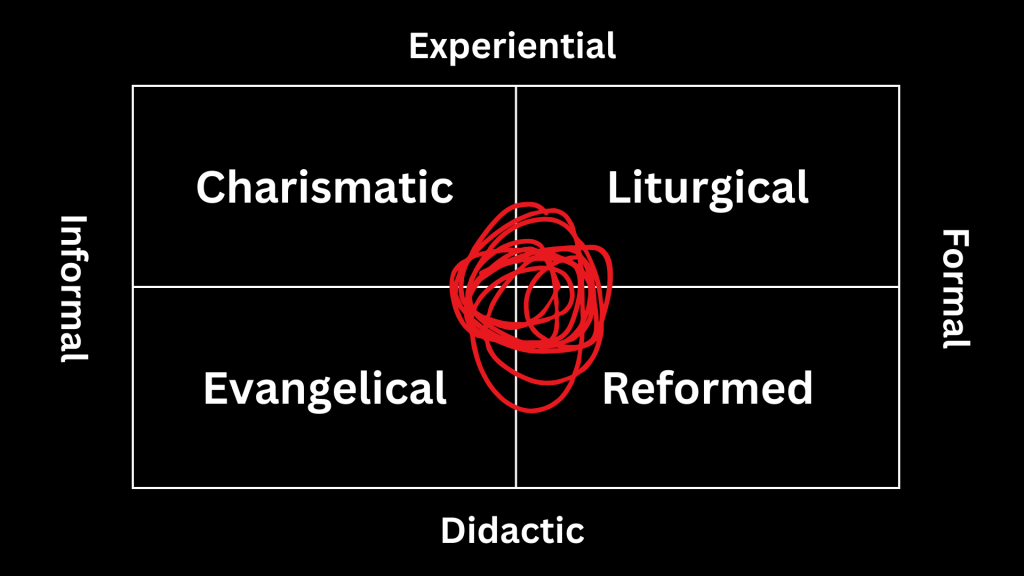
In this moment of conformity, we have settled into four camps. (By we: I mean evangelicals, and I use this word here in the broadest possible sense. I will use it again in a moment in a slightly different fashion, to describe a sub-category, I apologize for the confusion that will ensue!)

Here’s a handy chart!

And here’s a quick breakdown**: 

  • Liturgical churches
    • High structure (all churches have structure, but the high structure expression on this chart use structure as a feature: it’s part of their “thing”)
    • Strong experience (the liturgy is the driver for formation, not preaching)
    • Examples: some Presbyterian expressions, neo-Anglican, CRC, etc
  • Reformed churches
    • High structure (their structure is based on hierarchy rather than liturgy: in fact hierarchy is the organizing principle of life, from family and home, to church, to doctrine, etc)
    • Strong didactic (someone higher up in the hierarchy will tell you what to do)
    • Ex: Bethlehem Baptist (Piper), Grace Community (MacArthur)
  • evangelical churches
    • Low structure (structure is there, but it is for organizing ministry programs and building the organization, not a main feature. In fact, most non-denominational churches will downplay their structure, even though they might be HIGHLY organized)
    • Strong didactic (preaching is a primary feature, often the main vehicle for formation)
    • Ex: Saddleback, Willow Creek, etc
  • Charismatic churches
    • Low structure (similar ethos here to the evangelical churches)
    • Strong experience (here the experience is focused on worship, the Spirit, and prayer, rather than liturgy)
    • Ex: Hillsong, Elevation, etc

**Notes: this breakdown is pretty similar to John Mark Comer’s 4 gospels

This is a simplistic summary and I know practitioners of each would be pretty frustrated by my reductions. In real life, it’s more complicated and nuanced than this, we all get that (right?!).

Over my lifetime, there have been shifts of energy (and power) amongst these quadrants. In the 90’s the “evangelicals” were winning, in the late aughts and early 2010’s the neo-Reformed took over the discourse, and this decade the Charismatics are dominating. (More to say about all of this as we move forward.)

For now, the movement through the grid leads to a boring conformity and a lack of imagination. What I hope to point to, ultimately, is something like this…

…because what is going on in each quadrant is not “bad” per se, but the copy and paste mentality needs to go and be replaced by an integrative approach that recognizes the good gifts of different traditions, but reimagines them for specific contexts.

In my community (small college down in the middle of California), we have a LOT of coffee shops. We have a handful of Starbucks, a Peets, a popular Bay Area mini-chain, and a popular Sacramento shop that opened a store here (this is a common issue in Davis, we repeat cool Bay Area and Sacramento things rather than create our own).

I go to Pachamama. It’s one of the few truly local options (plus its model is really cool). My contention is that the church should be more like Pachamama than Starbucks, a local expression of Good News rather than a cut-and-paste copy.

Thank You Dallas Willard

The great Dallas Willard passed away yesterday and Jesus followers all over the world mourn the loss of one of Christendom’s greatest minds.

It has long been my contention that much of what we see emerging from the church today: from the actual “emergent” movement, to the Shane Claiborne/social justice crowd, to Willow Creek’s renewed focus on discipleship, to the “missional” cohorts, all of it is response to Willard’s monumental work, The Divine Conspiracy. Starting pulling on the thread of any of these movements and you don’t have to unravel much to get to Willard.

On a personal level, Divine Conspiracy was the first book I read “for fun” after graduating from college and it profoundly shaped not only my thinking but practical decisions about my vocation.

So, thank you Dallas, for calling us to actually follow Jesus, the master teacher, to be his disciples, and for reminding us of the counter-intuitive power of the upside down kingdom.

Also, Willard taught at the most revered institution of higher education in our household: the University of Southern California.

Fight On, Dallas.

Thursday Links

  1. Campus Ministry/Pastoring/Theology themes today…we begin with: Daniel Kirk posts about the importance of community in embodying the “presence” (the new temple).
  2. Ed Cyzewski on what every pastor secretly wants 
  3. Thom Ranier on the five biggest challenges for pastors
  4. The Faith on Campus “blogathon” has produced some great stuff including these two posts from Cor Chmieleski: One reminding us that there is no ministry silver bullet, and…
  5. How to use the summer to get ready for another year of work in campus ministry

NT Wright Quote of the Week

I just finished NT Wright’s excellent book on character and virtue: After You Believe. In it he argues winsomely to wrap up the quest for Christian character inside the ideas of worship and mission. They all go together. We pursue virtue and character as an act of worship and to help us in our mission.

He writes that the 4 big virtues are humility, patience, chastity, and charity. These four big words contain a bunch of other ideas (i.e. faith, hope, and love, the fruits of the spirit, etc). This section comes from his thoughts on chastity, but I would argue they really capture the essence of the book:

“Christians have always insisted that self-control is one of the nine fold varieties of Spirit’s fruit. Yes, it’s difficult. Yes, you have to work at it and discover why certain temptations, at certain times and places, are hard to resist.

“That because chastity is a virtue: it’s not first and foremost a rule which you decide either to keep or to break; it’s certainly not something you can calculate according to a principle, such as the greatest happiness for the greatest number; and in particular, as Jesus himself indicated, it won’t be generated by going with the flow of what comes naturally.

“This is where the genuinely celibate, like Jesus himself…have discovered the joy of a ‘second nature’ self-control which much of our culture, like most of the ancient world, never even imagines.

“By contrast, as those of us who care pastorally, or in families, for people who have embraced the present habits of society will know, the bruises and wounds caused by those habits are deep, long-lasting, and life-decaying. The church is often called a killjoy for protesting against sexual license. But the real killing of joy comes with the grabbing of pleasure…the price tag is hidden at the start, but the physical and emotional debt incurred will take a long time to pay off.

“Here Patience and Humility come into play once more. The frantic urge toward sexual intimacy is part of the drive to express yourself, to push yourself forward, to insist that this is who you are and this is how you intend to behave.

“No, says Humility; you don’t discover your true self that way. You find it by giving yourself away. Precisely, agrees Patience: taking the waiting out of wanting is short-changing yourself and everybody else. The virtues are linked together…if you want one of them, you better practice them all.”

Must Reads

Links of the Week:

  1. An interesting graphic on philanthropy (people will give money to colleges, will they give money to college ministry?)
  2. John Piper caused a stir with his “masculine feel to Christianity comment”…here’s an overview and some helpful responses
  3. Daniel Kirk with some great insight on what the Bible is for and the narrative approach
  4. Logan Gentry with some good thoughts on how missional communities can fail
  5. 2 posts from Scot McKnight’s blog on eschatology that is grounded in story versus escapism.