Thank You

I’m hoping to get back in a rhythm here at the ID, posting on a weekly basis. Let’s begin 2015 reflecting on gratitude and the wisdom gleaned from toddlers.

M is in a stage where she says thank you for things she’s received from others. For example:

When putting on shoes from a cousin: “Thank you, Nina.”
When playing with a toy from a friend: “Thank you, Bella.”
When putting on clothes from a grandmother: “Thank you, G,” or “Thank you, Grammy.”

(This is helpful because it reminds us to write thank you notes to people.)

She reminds me often to be grateful. And to be specifically grateful.

Gratitude is never truly practiced in generalities.
Gratitude must be specific.

There are too many people to thank, at least in this space, for all the help we’ve received over the past two months as we’ve transitioned from one coast to another.

Boston friends and family.
Salinas friends and family.
Oakland friends and family.

A million thank yous. Specific thank yous. Thank yous for food and visits. For carrying heavy boxes and packing and unpacking trucks. Thank yous for hospitality. And for spending time with our kids. For filling our pantry and refrigerator. And for big checks. And for so much more.

Thank you.

Check Your Mouth

I had the opportunity to share some thoughts on words at a church in California last weekend. Words have been on mind.

Which is partly why I find the following to be so fascinating:

Our two-year old daughter is growing more and more verbal with each passing day, but still struggles to fully express herself, the way that toddlers struggle with their emerging vocabularies. It can be frustrating at times. Super cute at others. And, incredible enlightening as well.

For example, whenever Marina is struggling with her attitude, or obedience, or just general human politeness we will ask her:

“Where are your manners?”

Or,

“Where is your happy heart?”

And she will point to her tongue and say: “Mouth.”

This, as I mentioned, is super cute. It is also deeply profound.

In fact, I think there is a proverb about this: [I actually enjoy the King James version here.]

“Keep thy heart with all diligence; for out of it are the issues of life.” [Pr. 4:23]

I also think Jesus had something to say about this:

“…for out of the abundance of the heart the mouth speaks.” [Luke 6:45]

Many times we are asked to examine our hearts. And this is a good and worthwhile practice. But, perhaps we also need to examine our words. Because our words reveal what is in our hearts.

So what are you talking about? What are you complaining about? What are you dwelling on? What subject can you never drop? What conversation do you always find yourself in? Are your words bringing life and joy and peace, or death and frustration?

Where is your happy heart? Check your mouth!

Happy Birthday!

Marina turns two today which, among other things, serves as the proverbial, cliched reminder that time does, indeed fly. Today I hit pause for a moment to reflect on two years of parenthood.

The first thing I would like say by way of observation is that nothing has been more disruptive to my life than becoming a parent. College was a time of transitioning and developing. Post-college brought new adulty realities into my life. Moving to Colorado to plant a church required a different level of growing up. And then marriage and moving to Boston accelerated the maturity process in all kinds of new ways.

But, nothing has been more disruptive than fatherhood.

The second thing I want to say is that this disruption has proven to be one of the greatest gifts I’ve ever received.

I say this because parenting has challenged me, has stretched me, has disrupted my selfishness and self-centeredness like nothing else. Nothing has revealed the dark parts of my soul quite as brightly as parenting.

I used to roll my eyes when my dad would say things to this effect. And certainly, I know many single people (or non-parents) who are incredibly mature and are light-years ahead of me in terms of character development.

I also want to say that I know many people who for whatever reasons are unable to have kids. Having experienced some challenges with fertility ourselves, I can also say that that challenge is every bit as forming as having kids. Maybe more so.

But, for me, and for many people I’ve talked to and pestered with questions, I understand like never before how important parenting is to becoming a mature adult with a character that has been tested and refined in the crucible of poop and fatigue and disciplining and trying to reason with a tiny, emotional human being.

God, I believe, gives us children to make us more like him.

Now, I know also know many people who had poor parental examples. I know and have heard so many stories of parenting done poorly. I know that simply reproducing doesn’t make you a better person.

But it does reveal what’s there unlike anything else. Some people look at what is revealed and choose to ignore it, run away from it, or deny it.

But if the revelation is embraced it can bring transformation. This I have also seen personally and in the lives of countless friends and family who have become incredibly beautiful people through embracing the challenges of parenting.

The last thing I would like to say, is that beyond life lessons and maturing, I am simply grateful for Marina. At two years old she is already a remarkable person, and we love discovering more about her all the time.

Happy Birthday, Kiddo! We love you!

IMG_1091

Take A Vacation

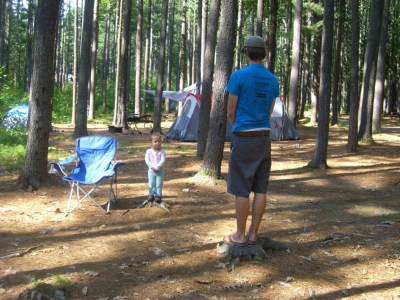
We went camping this weekend. This was M’s first time in the woods over night. She did great.

We ate bacon:

CIMG4258 (1)

We jumped off stumps:

CIMG4248

We tried hot chocolate for the first time:

CIMG4254

We practiced the spiritual discipline of looking at a body of water while pondering the deeper truths of life:

CIMG4236

At about 7 pm on Saturday evening, M was asleep, Amy and I were reading good books, all was peaceful in our campsite, and I was beginning to compose a post in my mind about the importance of sabbathing, of getting away, even just for a day, of decompressing. I was feeling it. Space, relaxation, the ability to breath deeply. All had been missing from recent weeks and months.

And then our neighbors came back. They were loud. They used “mother-effer” as a singular, jack-hammer adjective. They had extremely negative things to say about everything and everyone they had encountered during the day.

About an hour and a half later the fireworks started. This is not good writing as I lead into a description of an all-time-camping-neighbors-go-crazy-on-each-other-epic-throwdown fight. This was the 4th of July weekend and there were literal fireworks going off for over an hour. It sounded like war.

M slept through it. Her parents not so much.

And then the snoring. Snoring that could raise the dead. I have never heard anything like this before in my life.

M slept through it. Her parents not so much.

Sunday morning was glorious even though it started at about 5:30 am or whenever the sun rose. I guess this was our revenge. M fell off the table bench and started screaming. We were cooking bacon at 6:30 am. You’re welcome, everyone else in camp!

Sabbath’s are great (although, more difficult with small children), and I am all for them. In fact, I would guess somewhere around twenty percent of the posts on this blog have to do with rest.

But sometimes, you need a vacation.

I enjoyed our quick getaway. I regret that we don’t do this more often. But even twenty-four hours leaves a lot at the mercy of neighbors and weather (we lost one day of this trip to a tropical storm because Boston’s the weirdest) and fireworks.

Make sure you take a vacation.

Getting Used to Joy

Greg Boyle writes: “Delighting is what occupies God, and God’s hope is that we join in. That God’s joy may be in us and this may be complete. We just happen to be God’s joy. That takes some getting used to.”

—–

A common theme of this blog has turned out to be joy: losing it, finding it, maintaining it.

Some things that rob me of joy:
Car maintenance (and the cost thereof)
Fixing gadgets (and the cost thereof)

Especially the car. I love driving and I appreciate the opportunities a car affords, but I hate affording the car. It makes me grumpy and joyless in no time at all.

——

We read to our daughter from The Jesus storybook Bible every night. Some would say this is not a “real” Bible, but it is God’s word to us more often than not. I’m not sure how much Marina gets out of it, but I am cut to the heart almost every time we read.

Without fail, it seems, we come across a section called “The Singer” whenever I begin to worry about money, fundraising, our car, something that needs to be fixed, our budget, you name it. Without fail.

The Singer is essentially the sermon on the mount, with a special focus on Jesus’ admonition to “not worry”.

Conviction via the children’s Bible.

—–

I met with a student who graduated recently yesterday and she said, in the middle of pontificating on many things, a sort of off-handed comment: “when was the last time you were really surprised by something? I don’t want to lose my ability to be surprised.”

We got Marina some new silverware and bibs, and she got to try them out a few days ago. Her face lit up like Taylor Swift winning a Grammy.

Pure joy.
Total Surprise.
Joining in God’s delight.

Marina has an ability to be surprised, to not worry about stuff, and to delight that continues to rub the edges off my hard heart.

Those things that rob you of joy: conflict, cars, computer, whatever it might be, name them, but don’t allow them to kill your ability to be surprised, to delight.

We happen to be God’s joy. Get used to it.

Reality, Grace, Obedience [part 2]

I have a friend who has a daughter a few months older than Marina. He told me recently that they have started spanking. I know this day is coming for us, and so I asked how it was going.

My friend told me spanking is hard, but, in a strange way, his daughter draws closer to him afterwards. It might take a few moments, but post-spanking there is more affection, hugs, and snuggling than before.

Interesting.

—–

Our community group spent some time in conversation around the story in I Samuel 15 where King Saul blows it and essentially loses his Kingdom (which will eventually be turned over to David).

Saul is supposed to defeat an enemy and keep nothing (no slaves, no cattle, no good stuff). Saul does go on a rampage but he decides to take the enemy king alive and bring back all that is good (cattle and sheep and whatever else he liked).

The prophet Samuel shows up after this and asks Saul how it went. Saul tells Samuel everything went really well. And Samuel, brilliantly, asks “What is this bleating of sheep in my ears?”

I love this question. It is a reminder to me that I need Samuel’s in my life to ask the obvious question.

Sometimes we need people around us to just say: “Hey, I know you keep saying everything is fine and you are handling it, but I see this and this (I hear sheep bleating) and it doesn’t add up to ‘doing great.’ What’s the real story?”

—–

Grace is fundamental to the Christian worldview. Without God’s grace the world ceases to exist.

But, I find that many, many people misunderstand grace. Grace is not opposed to making wise decisions, maturity, or doing hard, unpleasant things.

Grace is actually what makes wisdom and maturity possible.

Back to Saul. After he realizes he screws up, he begs Samuel to come with him, make a sacrifice for him, and essentially bail him out of his trouble.

Samuel says, “No.”

God says, through Samuel: Does the Lord delight in burnt offerings and sacrifices as much as in obeying the Lord? To obey is better than sacrifice, and to heed is better than the fat of rams.”

My very human interpretation of this is: “Hey dude, if you had just done the right thing, the first time, we wouldn’t need to do all this work to make up for it.”

Grace is the fundamental reality that we don’t need to live in anxiety. That our identity and destiny are set.

But grace is not opposed to saying: “There is something better. You can do better.”

—–

Reality, obedience, grace.

I understand these words so much more as a parent. I don’t want to punish my daughter. But she has to learn, grow, and mature. It’s vital to her survival, and, more importantly, to her ability to thrive and excel at life.

So, is climbing the bookshelf the biggest deal in the world? Not really at one level (although if she continues to climb, she will fall and she will get hurt).

On another level, though, this is part of the process: learning what is in bounds and out-of-bounds, and, here’s the main point, learning the importance of obedience. Learning to trust.

When she screws up I want her to know that she is forgiven, and nothing about my love for her or her identity is ever in question.

But, I also don’t want her stuck in an endless cycle of “sacrifice.” I want her to mature and make decisions that are wise.

Because there are consequences to the choices we make. Grace certainly covers our sin, but it doesn’t eliminate the consequences of our decisions.

Grace calls us to be better, to grow, to mature.

So, a couple of questions:

  1. Are you stuck in a cycle of sacrifice?
  2. Who is your Samuel?
  3. Are you living in reality?

Reality, Obedience, Grace [part 1]

I taught recently on the passage in scripture where Jesus says “I am the true vine.” My main thesis, given that it was graduation Sunday, was that there are a lot of things you can give your life to, and in fact there are some things you can give your life to that are really good.

But, are those things true?

Jesus, in all of his I Am statements, is making the very radical claim that there are a lot of options, but only one way that is ultimately true.

—–

I read this post the other day, and I thought, as one who works with millennial, that there were many useful insights.

One thing the author says never to say to millennials is “stop being so idealistic…the real world doesn’t work that way.” I agree with the heart of this sentiment: we shouldn’t be killing the spirit of the next generation. Don’t be a wet blanket.

But, I also see idealism wielded as an ultimate trump card. A way to justify our own behavior and to do our own thing without being accountable to anyone, especially someone older, and potentially wiser, than ourselves.

[For the sake of integrity, I have used this trump card myself on too many occasions.]

—–

Of course, I also see a tremendous amount of cynicism, especially in my peers. A friend who just left the ministry told me a story about talking to another pastor who asked him, in so many words: “Doesn’t it feel so good to be out?!”

That kind of stuff kills me…I don’t ever want to be there.

Pastors do see the good, the bad, and the ugly, and there is a lot of the bad and the ugly, but we also know and preach and teach the good news about Jesus, which is fundamentally hopeful.

[For the sake of integrity I can be one crotchety, cynical mess at times.]

—–

Back to the vine. Jesus constantly cuts across the grain of all the false narratives we can construct for ourselves.

Idealism sounds so good, and presents itself in such a positive light, but it quickly runs off the cliff of reality, becoming a balloon floating on the wind with nothing to anchor it down.

Cynicism wallows in “reality,” but in a way that keeps everything at arm’s length to mask the pain we feel, and as a result becomes an un-reality.

The true vine gives life and sustains us because it is true. It is reality. Jesus, the good news of his resurrection, is what is real, and what is true, and what is sustaining.

I see too many people choosing to avoid reality: the reality of their situations, of the decisions they’ve made, of the challenges they face.

But avoiding reality leads us to shallow perspectives and prevents us from ever maturing.

Choose what is real.

On Being a Pro and Writing Stuff Down

A good friend who used to be on staff with us, recently transitioned into the “workforce.” He shaved, got some nice, professional clothes, and went to work at a job where if he screws up it will cost his company money and clients and (God forbid) worse.

I love my job, and I love being able to wear flip-flops and shorts to work, but if there is one thing that bothers me about ministry it is that a lot of people don’t treat it like “regular work”, for lack of a better term.

I saw this tweeted the other day:

“Be professional. Arrive on time. Actually be early. And be organized.

I offer up a wholehearted AMEN to that tweet. (Turns out the source is one of Brad’s articles, which you can read here, and it is very good).

I don’t know a lot of people who treat ministry with the professional mindset. In fact, there is almost an anti-professionalism that permeates a lot of Christian leadership. There are some good reasons for this. No one wants to be cold, distant, or a dictator.

What’s interesting to me is that many other non-traditional professions seem to revel in professionalism. I see this a lot in the writing/blogging world. You can read any number of posts and articles on the beauty of discipline, structure, and professionalism.

Why haven’t more ministry leaders adopted this mindset?

Some like to argue against my point by throwing the “in the world, not of the world” mantra back. And while I do think there are some ways in which we should think about ministry in different categories than the world (money comes immediately to mind), there are other ways (like being a pro) that should be held at an even higher standard than the regular workforce.

The other day our staff team was working on crafting content for our small groups this fall. We are going to talk about parables, and the parable of the Shrewd Manager came up in the conversation. It is a weird parable, and one that many people (myself included) struggle to understand.

In Luke 16:8 Jesus says:The master commended the dishonest manager because he had acted shrewdly. For the people of this world are more shrewd in dealing with their own kind than are the people of the light.”

I think this has direct application to ministry and work and professionalism.

We, in vocational ministry, should be just as shrewd (read: professional) in our work and craft as those who are in other vocational callings.

In addition to Brad’s list (I especially like 4, 5, 6, and 14, although I will print out the whole list and put it in my planner today), I would suggest 3 simple things to improve your professionalism:

  1. Write Stuff Down: in our technological world there are so many ways to store and keep track of things. I find that people who rely too heavily on the digital world tend to be more scatterbrained, forget more meetings, and lose things more often than those who write things down. This is not scientific data, but there’s something about putting pen to paper that, in my experience, seems to improve memory, demonstrate care, and produce results (like showing up, and showing up on time).
  2. Prepare: write stuff down before you go to a meeting, or a one on one. Prepare for those moments the way you would prepare for a talk in front of 50 people. And write stuff down afterwards so you don’t forget! (There’s a theme here).
  3. Act Like You Care: this means that sometimes you wear a shirt with a collar. Sometimes you call AND leave a voice mail (instead of texting). Sometimes you choose your words carefully (and you don’t use certain words you might use in other contexts). Sometimes you over follow-up. I could go on.

I am one of the more informal people you will ever meet, but I have found (sometimes from painful experience) that I want to err on the side of being a pro. It demonstrates care, it demonstrates a strong ethic of work, and it enhances (rather than diminishes) the legitimacy of what I do as a pastor.

Practice your craft, be a pro, and get a pen so you can write some stuff down!

A Shout Out to My Seniors

10014732_10102217582443835_688711228_oSpring Break 2014 will always hold a special place in my heart. Yesterday’s post unpacks some of the reasons.

There is one other big reason and it has to do with the students pictured above: (front L-R) Sarah, Anna, Bridget, Ruben, Faith, and Rebecca (front). For the purposes of this post Sarah is a stand in for Dorsa (although Sarah’s been a huge part of the larger Sojourn story and is going to intern with us next year, which is super exciting).

These six students (again substituting Dorsa for Sarah…Dorsa, unfortunately, couldn’t make this trip) will always be extremely special to me. They were all sophomores when I came over to BU in the fall of 2011, and took over as lead in the spring of 2012. There was quite a bit of turmoil and transition at the time, but, for whatever reasons, they stuck it out with me, and now they are really able to enjoy the fruit of that as their college careers come to a close.

It is not an understatement to say that there would be no SojournBU without these six. And because of their faithfulness they helped shape a community that will live on well after they graduate in May.

Rebecca has helped lead cadres and raised the bar in our conversations by bringing incredible insight and intelligence to the group. Faith is the “mom”, loving and caring for people well. Ruben brings the goofiness and an unparalleled commitment to, and passion for, community. Anna has done everything from hosting and leading groups, to fighting with student activities to make events happen, to pursuing freshmen, to being our guinea pig “public relations” intern. Dorsa is our radical lover of justice and people in the margins. And Bridget is the heart and soul of all we do, pulling off amazing events and bringing people closer to Jesus.

Our ministry is a million times richer for their contributions, and it is bittersweet to see them get ready to go.

And so, maybe the biggest reason this trip was so special is that we got to do it together.