A Quote About Stories

From The Story Factor by Annette Simmons:

“Story makes sense of chaos and gives people a plot. A story can help people make sense of their frustration. People don’t need more information. They are up to their eyeballs in information. They want faith…It is faith that moves mountains, not facts. Facts do not give birth to faith. Faith needs a story to sustain it–a meaningful story that inspires belief and renews hope.”

Pink Hats and Posers*

If the Patriots won on Sunday night, then I guarantee you that thousands of people (who had suddenly become Pats fans) would take the streets of Boston in riotous bliss. (It still happened at Amherst anyway).
Around the rest of the country this is known as being a “bandwagon” fan, but here in Boston we have an even more caustic and derogatory term for this phenomenon.Bandwagon fans here are referred to as “Pink Hats”.

The Pink Hat’s first appeared at Fenway Park in 2005 (as far as I know), the year after the Red Sox won their first World Series in 86 years.

A “pink hat” is the easiest way to spot a Poser…someone who is not a TRUE FAN. A “True Fan” is someone who has been through all the ups and downs, all the losing seasons, who has been to a million games…someone who has invested blood, sweat, and tears in to the team.

It’s funny though, the difference between a True fan, and a “pink hat”, isn’t that much. At the end of the day, neither one of them are REALLY on the team! They both pay for tickets, they both buy stuff from the team store, they both watch from the stands, and neither of them have had to catch a Tom Brady pass or try to hit a baseball over the Green Monster.

The Pink Hat isn’t the problem. The problem is the true fan thinks the pink hat hasn’t earned it…they are a poser, a hypocrite…

It is incredibly easy to slip into the trap of hypocrisy…which is why Jesus gives his disciples such a strong warning in Luke 12.

Our inner life and our outer life are NEVER in complete sync.We are never as true to our convictions as we’d like, we’re not always as honest as we want everyone else to be, and we sometimes pretend to be one way to hide the fact that inside we don’t actually feel it or believe it or live up to our own ideals.

In one way or another every human being is a hypocrite. As much as we want to believe that we are the true fans, we still wear pink hats…

Kinect for a Cause

We have brought over the X-Box Kinect to UMASS-Boston a couple of times. You can read some of my previous thoughts about this here. We did it again this past Friday but with a twist…to raise some money for our Spring Break to Joplin, MO. We are heading down there two weeks in a row (Northeastern and others March 3-10, and then UMB and BU March 11-18) to help rebuild after the tornado damage that hit last May.

I’m really excited about this trip for several reasons…I’ll give you few here: 1) One of our staff team members grew up in Joplin and some of our strongest supporters are from there. (2) I love that we are taking two trips this year and that students from at least 5 campuses are going. (3) I love that UMB and BU are doing this together, and (4) We’ve set a goal of raising $5000 to bless a family with the items they need to move into their rebuilt house.

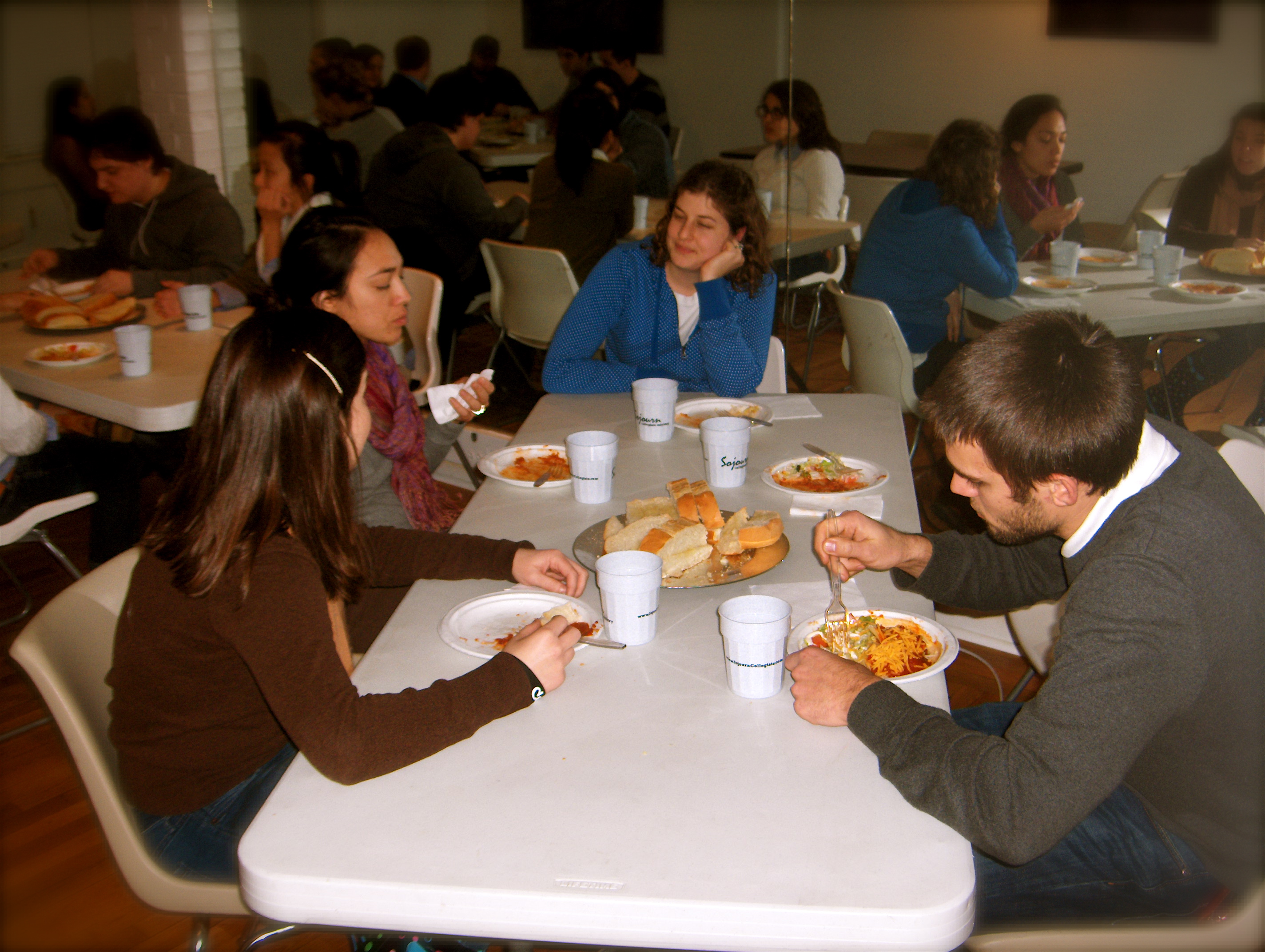
All of that to say, it was incredible to watch 60-70 UMB get together, have a great time hanging out, dancing, and getting to know each other better, and supporting our cause. A major part of the success of the event was the partnership of the UMBEvents crew who publicized Kinect like crazy. They even made a $40 donation. Very cool stuff. Huge win!

Community and the Extrovert Ideal

I started reading a fascinating book this week called, Quiet: The Power of Introverts in a World That Can’t Stop Talking. Without further ado, here is the quote (or quotes) of the week:

Today we make room for a remarkably narrow range of personality styles. We’re told that to be great is to be bold, to be happy is to be sociable…[as a result] many people pretend to be extroverts. It makes sense that so many introverts hide from themselves. We live with a value system I call the Extrovert Ideal–the omnipresent belief that the ideal self is gregarious, alpha, and comfortable in the spotlight.

And then, here’s the kicker:

Introverts living under the Extrovert Ideal are like women in a man’s world, discounted because of a trait that goes to the core of who they are. Extraversion is an enormously appealing personality style, but we’ve turned it into an oppressive standard to which most of us feel we must conform.

I have several reactions to this, but initially my thoughts turn towards community. I’ve had a number of conversations recently around the idea of community and when I pull them all together the picture (or working definition) of community that I get is of a large number of people who are together all the time and who do tons of fun things.

Is that true community though? Consider Jesus. He certainly interacted with a lot of people and at times had huge crowds around him.

That was not his community.

His community was 12 guys. These guys were a true community because:

  1. They were a manageable size.
  2. They had a mission (and a risky one at that).
  3. They spent a lot of “deep” time together.

Jesus also talked about the Kingdom of God as a party. He went to festivals and feasts. Again, he wasn’t afraid of the crowds.

But I wonder if the Extrovert Ideal hasn’t warped our idea of what authentic community really is. And that is pretty interesting to me.

More to come from this book, I am sure!

Options, Sabbath, and Saying NO

The more I work with students the more overwhelmed I become at the number of options they have to choose from. Literally, everything (class, living situations, activities, what to eat for dinner) is a decision from among multiple options.

Most students don’t struggle with filling up their schedules, they struggle with saying yes and no to the right things.

If I’m being honest, I have the same struggle. Amy and I could be involved in a churchy opportunity (to quote Nacho Libre) every day and/or night of the week (and some weeks we are).

The question is almost never one of finding a good options, it’s trying to figure out, to discern, what is the best option. Many of us solve this problem by saying yes to everything.

Or maybe (if it’s a Facebook event). We all struggle with saying no. Maybe that’s why Jesus said this.

Saying no is important, even vital, for life.

—–

My friend has been telling about his teenage daughter and the struggle with being “on” all the time. Thanks to phones, Facebook, etc the only time she is ever “off” is when she is asleep.

As a result, the burden of carrying a constant emotional weight can be crushing. They’ve instituted a “no-phone-or-computer-after-8-pm” policy (it’s voluntary but appreciated). I’m trying to do a similar thing. It’s hard.

But it’s a no that opens up the possibility of saying yes to some really good things.

—–

Sabbath is a Christian practice in saying yes and no. Often, though, it is framed as saying no to work.

It’s more layered than that, though. It’s saying no to finding our identity in work, in production, in achievement, in connection. Walking away from work (or the phone, or the blog, or the inbox) for a time frees us from slavery to those things.

Which is beautiful. But even one more layer down, it is a reminder that the world goes round without me pushing it. People will be ok without me. God is in control.

—–

I stink at saying no. I would much rather just say yes to everything. Have all the experiences I can have. Keep everyone happy. Not miss out on anything.

But I distort my own importance and tell myself (and others) that the world revolves around me if I don’t say no, even to good things.

What do you need to say no to?

“Busy is the symptom not of commitment but of betrayal…not of devotion but of defection.” – Eugene Peterson

On the Entrepreneurial Spirit

I’m reading a fascinating book called My Korean Deli. It’s the story of a convenience store in Brooklyn (and it is quite the story). Anyone who has lived in the city has seen, and been in, one of these ubiquitous establishments at some point (if not every day).

It’s a fascinating read for a number of reasons: race and immigrant issues, inter-racial marriage dynamics, neighborhoods in transition…it’s got a little bit of everything.

In ministry, especially start-up campus ministry and church planting you have to embrace the entrepreneurial spirit at some level or else you are in trouble. Ben Howe, the author, perfectly captures the difficulty of the entrepreneur:

“The thing about business is that, like anything else, it takes a while to figure out how you’re really doing. You’re like a pilot whose dashboard instruments don’t function until the plane has reached cruising altitude–you don’t know how fast you’re going, how high you are, or how close you are to stalling and dropping out of the sky. There just isn’t enough information, and what there is you don’t know how to interpret…beginner’s errors distort the picture…ballpark guesses often turn out to be rosy-picture guesses.”

And then this:

“No matter how mixed the evidence, to a fledgling entrepreneur the future always looks shiny and bright, doesn’t it? You’re in business, you have a store, and it has customers, which might seem like modest accomplishments, but it’s the beginning and it’s hard not to succumb to the delusion that things can only get better.”

That is good stuff, especially in ministry when defining the “bottom line” can get tricky. Doing something, does not always equate with quality. A good reminder, for me, that clarity in big goals brings clarity in smaller things.