
Tag: Books
Obama, Fatherhood, Personality, Reading, etc.
- Obama says fatherhood is more important than schmoozing
- Fascinating infograph on personality types and the use of social media
- Reading reduces stress!
- Adam McLane on the upside of negative feedback
- Eugene Cho on the women of the political conventions
Review: Adventures in Churchland
I had two extremely formative experiences as a college student. My involvement with campus ministry through the InterVarsity chapter at Pacific forever altered the trajectory of my life. That is where Jesus found me and got a hold of my life.
The other experience(s) occurred in the form a monthly (sometimes more frequent) pilgrimage over the hill to Santa Cruz to a place called Graceland. Graceland started off as Santa Cruz Bible Church’s college and young adult ministry, then became a “church within a church,” and then eventually the leadership launched out on their own.
InterVarsity gave me the space to explore Jesus and my first halting attempts at leadership and ministry, and Graceland sparked my imagination for what a church could look like.
In particular, Dan Kimball, the lead pastor, taught interesting sermons, had interesting hair, and new all of the bands that I liked (back when I was a music snob). He is also an introvert and a deep thinker who wears black jeans all the time and his example was extremely helpful to me at that point in my life and journey towards full-time ministry.
For the last ten years I have read his books and blog and followed the Vintage Faith story from a distance. His most recent work is also his most personal: Adventures in Churchland. Dan has written an apologetic for the church, something desperately needed in a time when the church fails to capture the imaginations of so many in our culture.
Dan tells some hilarious stories as he outlines his personal journey from totally secular rocker to lead pastor and church apologist. He also spends a good part of the middle of the book reframing a couple of popular misconceptions about the church. Both are strong aspects of the book.
But where Dan really hits his stride is near the end, where he invites us to fully commit to this messy, beautiful thing called church. He compares the church to a mosh pit, this thing that is supposed to be fun and passionate but all too often leads to cuts and bruises. When this happens to us we almost always bail, in search of something better, more perfect. Instead of searching for perfection we should ask: “What mess will I choose to be in? And even more important, How might God use me to help clean up this mess?”
Finally, Dan describes individuals as God’s poema: a work of art, a work of a master craftsman. This individual work only becomes complete when part of a whole. “Without your contribution, the church is missing something that only you can bring.“
Which is exactly right: sometimes we fail to get involved out of fear (this might hurt me), sometimes we refuse to get involved (because of a bad experience), sometimes we hold back (if I get rejected at least I didn’t give my best), and in each case everyone loses.
Everyone wins though when we lay down our agendas and roll up our sleeves and join in with God and others in the work he is doing. Dan’s journey from churchland to graceland is a beautiful story and I hope many people rediscover the good news that comes through being involved in a local church as a result of reading this book.
Review: Why Holiness Matters
This month I will highlight a couple of books by friends and acquaintances. Up first is Tyler Braun‘s Why Holiness Matters. I first came across Tyler when I read this post and discovered we have some overlap in our stories. Here’s my review of his first book.
—–
Peel back the layers and you will find that one of he greatest fissures in modern Christian thinking lies between authenticity and rule keeping. Most people won’t lead with either of these labels, but they are there.
I work with college students and we have both types of students: those who just want the rules, just want a checklist, and those who use the quest for authenticity as a trump card, justification for poor decisions.
There is a third way, though, and this way is the subject of Tyler Braun’s strong effort: “Why Holiness Matters.” Braun argues that while most in the millennial generation will resonate with authenticity thinking, there is something better that Jesus offers: holiness.
Braun does his best work by taking this old idea and making it new and fresh for his contemporaries (although there’s plenty here for non-millennials as well).
I appreciated Braun’s relational approach to the conversation: holiness is not new (or better) behaviors, nor is it something we simply feel (or drift) our way into. Rather holiness begins with new affections. Our relationship, love of, and connection to a holy God leads to holiness.
I especially enjoyed the chapters on community and mission. Braun does well to emphasize that holiness is a communal process and draws us into community, it’s not a solo pursuit. But, holiness doesn’t lead us to lock the doors and keep the bad people out. We are compelled back into the world to love and serve our neighbors.
A solid effort, and a book I will likely use with students this year.
Sometimes we don’t need new words, we just need new definitions and conversations about good, old words.
Game Change
I wrote yesterday that Game Change is possibly my favorite read of the summer. Whatever your political views, the 2008 presidential election cycle was high drama and full of compelling stories. The authors focus on four campaigns (Obama, Clinton, Edwards, McCain), providing all kinds of interesting background.
There are, undoubtedly, numerous reasons why Obama won. But as I was reading two aspects of Obama’s campaign stood out to me again and again:
- The Obamans (as the authors refer to the campaign) had a motto: no-drama-obama. They knew stuff would come up, they new their opponents would hit them hard, but throughout the whole thing Obama was about at straight-line as you can be. Very few ups and downs, very few emotional outbursts, and a lot of methodical, rational decision-making. Clinton on the other hand: wildly emotional, a roller coaster of highs and lows. McCain: wanted as little information provided to him as possible (Obama on the other hand puts baseball nerds to shame with the amount of information he processes)…as a result McCain was all over the place, following his gut instincts to the bitter end. Edwards, well, you can only imagine the drama there.
- The other fascinating thing to me was this: Clinton, Edwards, and McCain all had one person on their team who was highly competent and extremely dysfunctional. Extremely. (You could argue that Hillary had two of these people in her camp if you include her husband). Each of these people caused fissures on their team that proved, in the end, to be fatal. Obama had some personalities on his team too. But, the Obamans got caught up in the historical nature of the campaign (you might say they remained focused on the mission) and that kept some of the personality and ego issues to a minimum.
Fascinating stuff and a lot of implications for leaders: keep things steady and focused and choose your team well!
Summer Reading, Part II
- On Some Faraway Beach The Life and Times of Brian Eno: A little too fanboyish to be a great biography, but still an interesting read about one of the most influential music producers of the last 40 years (Bowie, Taking Heads, U2, Coldplay)
- A Hologram For The King: Eggers’ attempt to tell a story of the financial crisis…some parts hit and some miss. Where he hits Eggers continues to be one of my favorite writers, but where he misses it just feels like he’s trying way too hard.
- Game Change: Absolutely fascinating…my favorite read this summer…more on this one tomorrow.
- Why Holiness Matters: Also more on this one soon…check out Tyler’s blog
- Bob Dylan in America: Historians’s take on different eras of Dylan’s work…interesting connection to other artists like Aaron Copland.
30 Weeks
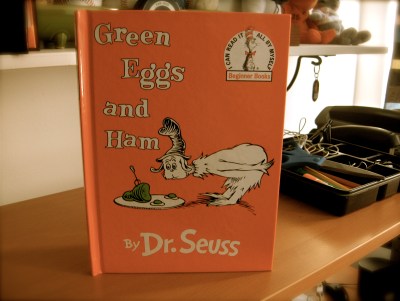
Continuing the theme of baby related supplies, we added a Dr. Seuss book to the collection this week (I might be using this in my teaching on Sunday too, so that’s pretty exciting).
30 weeks down, two months to go. Getting antsy to meet this kid!
Summer Reading
Summer is a great time to inhale some books. With a kid on the way I feel an added sense of pressure to get as much in as possible because, come September, who knows what reading time will look like! Here are my top 5 books from June:
- The Road Trip That Changed the World by Mark Sayars. I did not agree with some of his conclusions in the last third, but the first 150 pages are some of the most interesting cultural exegesis I have read in a long time.
- The Honest Truth About Dishonesty by Dan Ariely. Essentially this is a book about sin and integrity written by a social scientist. His analysis and conclusions about lying, cheating, and stealing will give you plenty to talk about.
- Life by Keith Richards. Absolutely fascinating…Keith has a lot to teach anyone who is a leader.
- Holes by Luis Sachar. This is a re-read, but totally worth it. I’ve going back through my “children’s lit” section and this is a great book, period, child or not. And, if you don’t like it Ryan will hunt you down and give you the what-for.
- The Juvenilization of American Christianity by Thomas Bergler. This is only number 5 because I have actually finished it yet, but so far he has some pretty startling things to say to those of us working with young people.
Like a Rolling Stone (The Radar is On)
I’ve been reading Life by Keith Richards and it’s fascinating for all the reasons one might suspect: the inside rock’n’roll story, the gossip about Mick, and the revelations about where the songs came from (Jumpin’ Jack Flash is a good one).
All that aside, what interests me about this book is not juicy stories of debauchery and came-from-nothing-to-make-it-big exuberance, but the insight it provides about longevity.
The Rolling Stones turn 50 this year. 50 years as a band. That’s a great marriage. No one stays in the game (let alone on top of the game) for 50 years in the music industry.
I don’t know the secret to that yet. I’ll let you know if I find out. But along the way Keith has some great insights to a whole bunch of things…creativity, cultural change, doing what you love to do.
Here’s a bit about the creative process (he’s talking about songwriting but I think you can insert writing, preaching, anything creative):
“Because you are playing, working, every day…ideas are flowing. One thing feeds the other. You may be having a swim or whatever, but somewhere in the back of the mind, you’re thinking about this chord sequence or something related to a song. You might be getting shot at, and you’ll still be ‘Oh! That’s the bridge!’ And there’s nothing you can do; you don’t realize its happening. It’s totally subconscious, unconscious or whatever.
The radar is on whether you know it or not. You cannot switch it off.
You’re constantly on the alert…You start looking around, and everything’s a subject for a song. The banal phrase, which is the one that makes it. And you say, I can’t believe nobody hooked up on that one before!”
A Current of Anger
Quote of the week from the fascinating book: The Road Trip That Changed The World by Mark Sayers.
“We attempt to escape the mundane through seeking out transcendent experiences. Yet the essence of transcendence is rooted in ‘the other,’ the transcendent is mysterious because it is not known, it is otherly. The culture of illusions, peddling pseudo-transcendence, will always leave us unsatisfied because it does not lead to another, it simply leads back to ourselves.
Underneath all of these pseudo-events there is a dark side to the ‘whoosh’ culture, a current of anger, a resentment against the ‘dream not coming true,’ about the ideal being crushed by reality.”
 stephenboutrywords